CSW 2026 November Moment 2025

‘November Moment’ 2025

November 2025: The Month of the Holy Souls
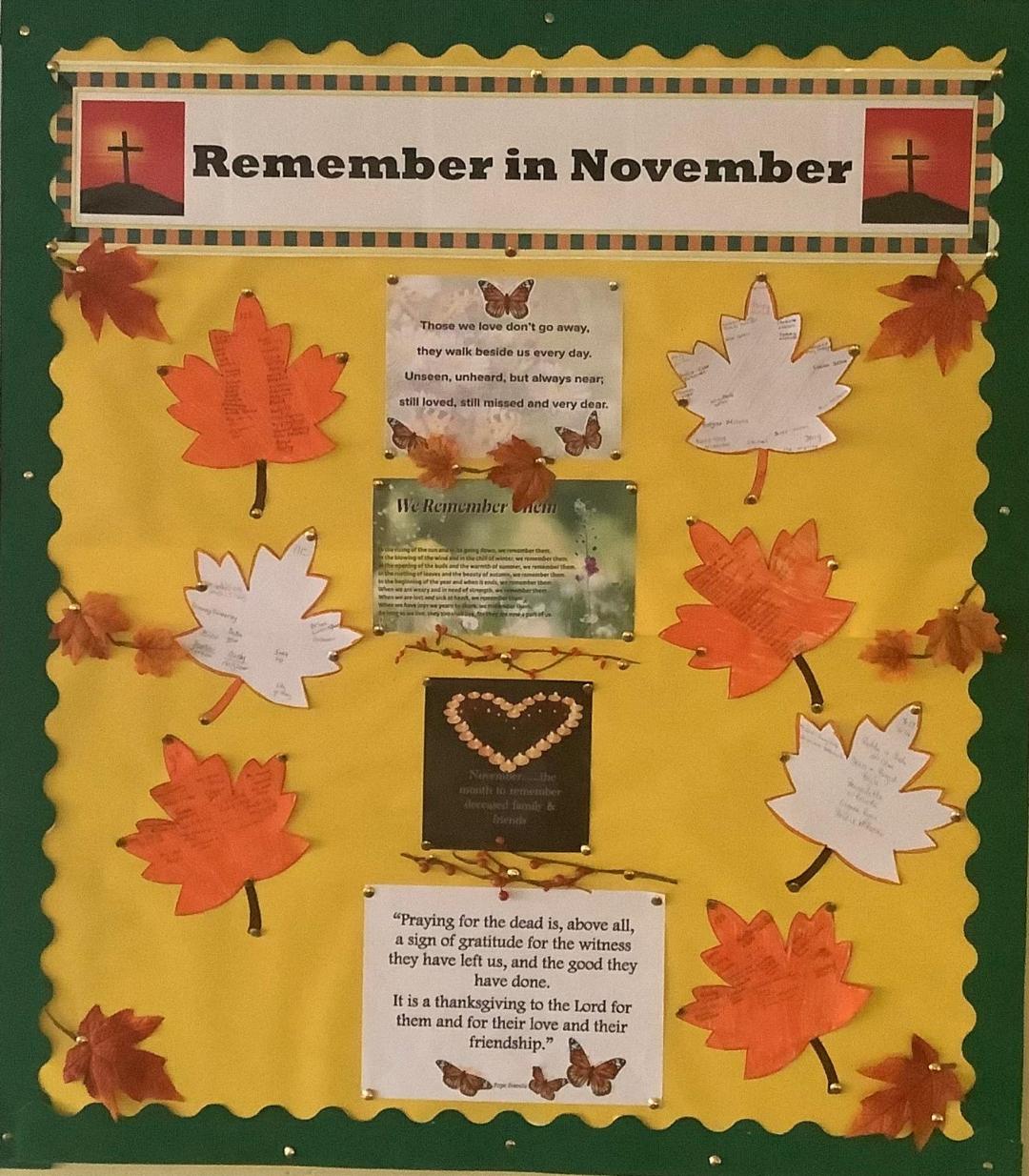
St Catherine’s College November Display Board Thanks Roisin !

‘Holiness does not mean performing extraordinary things, but doing ordinary things with love and faith.”
— Pope Francis on Blessed Carlo Acutis

As we look forward to celebrating Catholic Schools Week 2026, in the month of November we remember and pray, in a special way, for all those who have died and gone before us in the hope of the resurrection.

The theme for Catholic Schools Week in January 2026 is ‘Catholic Schools: Normal Lives, Called to Holiness’.
This ‘November Moment’, traditionally called the month of the Holy Souls, is a space in our year to recall those who have lived their lives before us and perhaps reflect on their holiness. It is a space to remember the normal, ordinary activities of their lives, carried out in love and faith, which made their holiness alive to us.

There may be sadness in remembering, but there can also be moments of joy and especially hope when we remember our loved ones who have died and pray that they live with God in heaven.

Our ‘November Moment’ pack is a resource that aims to assist and support schools with activities and lesson ideas for the month of the Holy Souls. The pack has a variety of resources to choose from – music, scripture readings, prayers and activities. It includes a worksheet and a suggested prayer service or ritual, or you can design a custom-made prayer service or ritual using some of these elements in whatever order suits your class or school situation.

The resources are available below:

Primary

Gaeilge
English

Post Primary

Gaeilge
English

.

CATHOLIC SCHOOLS WEEK 2026 (18th to the 24th January 2026)

Catholic Schools – Normal Lives, Called to Holiness

“Holiness does not mean performing extraordinary things, but doing ordinary things with love and faith.”

— Pope Francis on Blessed Carlo Acutis

Introduction

Catholic Schools Week 2026 celebrates the extraordinary call to holiness in the midst of ordinary life. Inspired by Pope Francis’s reflection on Blessed Carlo Acutis—soon to be canonised as the first millennial saint—this year’s theme invites pupils, teachers, families, and parishes to explore the call to holiness as something both universal and accessible. Holiness is not for a few, but for all; not reserved for religious professionals or mystics, but for every student, teacher, parent, (and grandparent!) living each day in friendship with Jesus Christ.

Catholic schools exist to form individuals who know that their lives have a purpose and a calling. This year’s theme, “Normal Lives, Called to Holiness,” resonates with the central conviction that education is a path not only to knowledge and maturity but to sainthood.

“Each of us is called to be holy by living our lives with love and by bearing witness in everything we do.”

— Gaudete et Exsultate, 14

Key Theme: Everyday Holiness

This theme offers a meaningful opportunity to speak to children and young people about how God calls each of us to holiness in the concrete circumstances of daily life. It allows us to:

  • Introduce students to modern saints like Blessed Carlo Acutis, who lived an ordinary teenage life with extraordinary faith.
  • Highlight saints who lived in families, went to school, worked in trades, or suffered illness.
  • Explore the meaning of holiness as a loving relationship with Jesus Christ, lived through prayer, service, courage, love, and joy.
  • Emphasise the role of the Eucharist, the Scriptures, and Christian friendship in forming a holy life.

As Pope Leo XIV recently affirmed:

“The saints show us that holiness is not about escape from the world, but deep engagement with it in the Spirit of Christ.”

Daily Themes

Each day of the week reflects a different dimension of our call to holiness:

Monday: Called to Holiness through Prayer
Holiness begins with a relationship with God. Children will learn that prayer is the lifeblood of that relationship—from silent moments to joyful praise, from formal prayers to personal words shared with Jesus.

Tuesday: Called to Holiness through Love and Friendship
Holiness is lived in love of neighbour, in kindness, forgiveness, and friendship. Inspired by the words of Jesus, “Love one another as I have loved you” (John 15:12).

Wednesday: Called to Holiness in Family Life – Grandparents’ Day
A cherished tradition, this day honours the vital role grandparents and elders play in passing on the faith and in showing how holiness can be lived over a lifetime. Pupils will be encouraged to show gratitude and celebrate their family roots.

Thursday: Called to Holiness through Service and Courage
Young people will explore how self-giving love and courage in the face of challenges form part of holiness. Stories of saints who served the poor, forgave their enemies, or stood up for what is right will be shared.

Friday: Called to Holiness through Joy and Mission
Holiness is not grim but joyful! The final day focuses on the joy of the Gospel and how young people are called to be missionary disciples who share Christ through action and word in the world.

Support Resources

Resources for Catholic Schools Week 2026 will include:

  • Daily classroom reflections and activities (Junior Infants to Leaving Cert).
  • Suggested Scripture passages and short prayers.
  • Profiles of saints (e.g. Carlo Acutis, St. Therese of Lisieux, St. Josephine Bakhita, Bl. Pier Giorgio Frassati).
  • Multimedia content developed in collaboration with CCO to support social media campaigns and classroom engagement.
  • A poster and theme logo for school display.

Pedagogical Integration

CSW 2026 aligns with the ethos of Catholic education and with current curriculum developments:

  • SPHE: exploring human dignity, resilience, and friendship through a Catholic lens.
  • Religious Education: drawing on themes of sainthood, sacramentality, and Scripture.
  • Wellbeing: understanding spiritual wellbeing as integral to personal flourishing.
  • Digital Literacy: engaging with Carlo Acutis’ story as a way of exploring positive online presence and ethical technology use.

Conclusion

Holiness is not an achievement but a gift—a gift that God offers to each of us in the ordinary rhythm of our days. During Catholic Schools Week 2026, let us joyfully proclaim with Pope Francis: “Do not be afraid to be saints!”

Catholic schools are communities where every pupil can discover that their life matters, that they are loved by God, and that they are called to be saints—not in some distant way, but right now, today, in the classroom, the playground, and at home.

“The measure of holiness stems from the stature that Christ achieves in us, to the extent that, by the power of the Holy Spirit, we model our whole life on his.”

— Gaudete et Exsultate, 21
October Month of the Holy Rosary

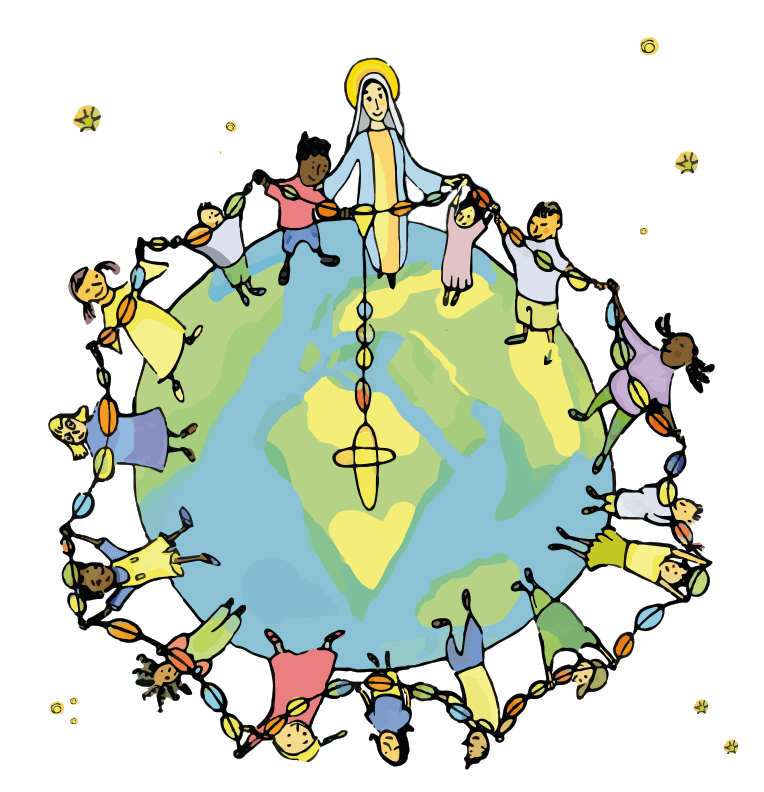
‘One million children praying the Rosary’ campaign

  • ICN Article Oct 6th, 2025

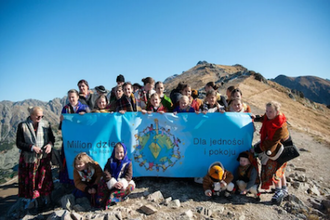
Children from Poland take part in ACN's One Million Children Praying the Rosary.

Children from Poland take part in ACN’s One Million Children Praying the Rosary.

Source: Aid to the Church in Need

October is traditionally the month of the Rosary, and this year it takes on a special significance with the Holy Father’s call to pray daily for peace. On October 11, as part of the Jubilee of Marian Spirituality, the Pope will lead the Rosary in St Peter’s Square.

Aid to the Church in Need (ACN) joins this great appeal through the initiative ‘One Million Children Praying the Rosary;. On October 7, the Feast of Our Lady of the Rosary, ACN is inviting children from around the world to gather in prayer in their parishes, schools, and families. So far, almost 100,000 have already registered to take part.

ACN International president Cardinal Mauro Piacenza’s appeal for prayer as a necessity in a “world wounded by division, conflict, and suffering” struck a particular chord with many of those who committed to participating in the event.

“We fully share your concern about the alarming increase in violence, hatred, and division across the world. In these troubling times, we truly believe that prayer, especially the Rosary, remains our most powerful spiritual weapon for peace, unity, and the protection of innocent lives,” writes the Diocese of Faisalabad, Pakistan, to ACN.

“Rest assured, we will actively promote this campaign throughout our diocese. Our schools, parishes, and catechetical centres will be invited to unite with children from across the world to raise their voices in prayer for peace and reconciliation,” he adds.

In neighbouring India, Bishop Theodore Mascarenhas of Daltonganj also says that in these times “this invitation to unite the voices of children in prayer is both prophetic and profoundly necessary. I wish to assure you that as a diocese, we fully support this initiative and will do all we can to make it a meaningful and well-participated moment across our parishes, schools, and mission stations”.

Children in Myanmar will also be taking part, with one response from the country saying “please be assured of our spiritual closeness. We will gladly ask our priests and religious to animate the children to join you, uniting our intentions with yours and with all who participate in this campaign. Truly, Our Lady must be smiling upon all the prayers and graces that have flowed from these 20 years of devotion.”

Responses also came in from South America, with Bishop Adalberto Jiménez from the Apostolic Vicariate of Aguarico saying that “from our jungles and rivers, our schools and chapels, from the green heart of the Ecuadorian Amazon, we come together with filial love to the Virgin Mary, and with hope for the future of the world, which we place in her hands”. The bishop is expecting at least 2,500 children and 7,000 adults to participate.

Bishop Leopoldo Ndakalako of Menongue, Angola, describes the campaign as “a great, unique and opportune initiative, especially at this time in history”. He adds that “the diocese will do everything it can so that our children, and indeed the whole diocesan community, takes part”.

While pledging the support of his diocese as well, Bishop Bruno Ateba of Maroua-Mokolo, Cameroon, says that “you are right to say that terrorism, war, violence, hatred and division are gaining ground, and the number of people in distress is increasing all the time. Our help is in the name of the Lord, who made heaven and earth.”

Fr Yakobus Warata, provincial of the Congregation of the Most Holy Redeemer, Indonesia, says that “in a time marked by growing violence, division, and suffering, your words are a timely and powerful reminder that our response must be grounded not only in action, but also in deep and united prayer,” adding that “we are convinced that the innocent prayer of children has a unique power to touch the heart of God and to call down peace upon our troubled world”.

This was also echoed by Fr Shelton Dias of the Archdiocese of Colombo, Sri Lanka, who expresses his firm belief “that the power of prayer, mainly the power of the Rosary can change the world. Nothing can overcome the power of prayer.”

As of now, there will be over 8,000 children praying the rosary for peace in Ireland this Tuesday. ACN in Ireland says: “This is a truly remarkable statistic and has only become possible due to the widespread cooperation of schools, so thank you to all of the teachers who have expressed interest in the event and will be devoting a portion of their Tuesday to praying the rosary with their young pupils.”

There is still time to download free resources at: www.acnireland.org/pray-the-rosary-campaign

This is the twentieth consecutive year of the prayer campaign, which began in 2005, as a small event in Venezuela. In 2023, for the first time, over one million children officially took part, and the same happened in 2024.

Parishes, movements, schools and families are asked to pray during October, but especially on 7 October, the Feast of Our Lady of the Rosary, which will send “a tidal wave of prayer around the world, sprung from the hearts of children and uttered in childlike trust”, according to Fr Anton Lässer, ecclesiastical assistant to ACN International.

Check out October in former posts for resources

Catholic Schools Week 2026 Catholic Schools – Normal Lives, Called to Holiness

Catholic Schools Week 2026 will run from 18th to the 24th January 2026

Catholic Schools – Normal Lives, Called to Holiness

“Holiness does not mean performing extraordinary things, but doing ordinary things with love and faith.”

— Pope Francis on Blessed Carlo Acutis

Introduction

Catholic Schools Week 2026 celebrates the extraordinary call to holiness in the midst of ordinary life. Inspired by Pope Francis’s reflection on Blessed Carlo Acutis—soon to be canonised as the first millennial saint—this year’s theme invites pupils, teachers, families, and parishes to explore the call to holiness as something both universal and accessible. Holiness is not for a few, but for all; not reserved for religious professionals or mystics, but for every student, teacher, parent, (and grandparent!) living each day in friendship with Jesus Christ.

Catholic schools exist to form individuals who know that their lives have a purpose and a calling. This year’s theme, “Normal Lives, Called to Holiness,” resonates with the central conviction that education is a path not only to knowledge and maturity but to sainthood.

“Each of us is called to be holy by living our lives with love and by bearing witness in everything we do.”

— Gaudete et Exsultate, 14

Key Theme: Everyday Holiness

This theme offers a meaningful opportunity to speak to children and young people about how God calls each of us to holiness in the concrete circumstances of daily life. It allows us to:

  • Introduce students to modern saints like Blessed Carlo Acutis, who lived an ordinary teenage life with extraordinary faith.
  • Highlight saints who lived in families, went to school, worked in trades, or suffered illness.
  • Explore the meaning of holiness as a loving relationship with Jesus Christ, lived through prayer, service, courage, love, and joy.
  • Emphasise the role of the Eucharist, the Scriptures, and Christian friendship in forming a holy life.

As Pope Leo XIV recently affirmed:

“The saints show us that holiness is not about escape from the world, but deep engagement with it in the Spirit of Christ.”

Daily Themes

Each day of the week reflects a different dimension of our call to holiness:

Monday: Called to Holiness through Prayer
Holiness begins with a relationship with God. Children will learn that prayer is the lifeblood of that relationship—from silent moments to joyful praise, from formal prayers to personal words shared with Jesus.

Tuesday: Called to Holiness through Love and Friendship
Holiness is lived in love of neighbour, in kindness, forgiveness, and friendship. Inspired by the words of Jesus, “Love one another as I have loved you” (John 15:12).

Wednesday: Called to Holiness in Family Life – Grandparents’ Day
A cherished tradition, this day honours the vital role grandparents and elders play in passing on the faith and in showing how holiness can be lived over a lifetime. Pupils will be encouraged to show gratitude and celebrate their family roots.

Thursday: Called to Holiness through Service and Courage
Young people will explore how self-giving love and courage in the face of challenges form part of holiness. Stories of saints who served the poor, forgave their enemies, or stood up for what is right will be shared.

Friday: Called to Holiness through Joy and Mission
Holiness is not grim but joyful! The final day focuses on the joy of the Gospel and how young people are called to be missionary disciples who share Christ through action and word in the world.

Support Resources

Resources for Catholic Schools Week 2026 will include:

  • Daily classroom reflections and activities (Junior Infants to Leaving Cert).
  • Suggested Scripture passages and short prayers.
  • Profiles of saints (e.g. Carlo Acutis, St. Therese of Lisieux, St. Josephine Bakhita, Bl. Pier Giorgio Frassati).
  • Multimedia content developed in collaboration with CCO to support social media campaigns and classroom engagement.
  • A poster and theme logo for school display.

Pedagogical Integration

CSW 2026 aligns with the ethos of Catholic education and with current curriculum developments:

  • SPHE: exploring human dignity, resilience, and friendship through a Catholic lens.
  • Religious Education: drawing on themes of sainthood, sacramentality, and Scripture.
  • Wellbeing: understanding spiritual wellbeing as integral to personal flourishing.
  • Digital Literacy: engaging with Carlo Acutis’ story as a way of exploring positive online presence and ethical technology use.

Conclusion

Holiness is not an achievement but a gift—a gift that God offers to each of us in the ordinary rhythm of our days. During Catholic Schools Week 2026, let us joyfully proclaim with Pope Francis: “Do not be afraid to be saints!”

Catholic schools are communities where every pupil can discover that their life matters, that they are loved by God, and that they are called to be saints—not in some distant way, but right now, today, in the classroom, the playground, and at home.

“The measure of holiness stems from the stature that Christ achieves in us, to the extent that, by the power of the Holy Spirit, we model our whole life on his.”

— Gaudete et Exsultate, 21
More information will be posted as available Declan

Rosary for Peace 24.

More than a million children to pray the Rosary for peace

  • Amy Balog ICN Article from Daily ICN Newsletter
  • Sep 18th, 2024

A Catholic charity is hoping to exceed last year’s milestone of more than a million children joining a campaign to pray the Rosary for peace in the world’s conflict zones.

Aid to the Church in Need (ACN) is holding its ‘One Million Children Praying the Rosary’ initiative for the 19th year in a row today (Wednesday, 18th September).

ACN (UK) National Director Caroline Hull said that the charity is “hoping to surpass last year’s record of 1,039,628 children praying the Rosary for peace around the world”.

She added: “We would like to invite all our friends and benefactors here in the UK and beyond to encourage all the children they know to join this powerful initiative inspired by Our Lady of Fatima.”

This year’s motto – “Pray the Rosary and there will be peace” – places at the centre of the campaign the request made by Our Lady of Fatima in 1917.

Through this initiative, ACN is also participating in the ‘Symphony of Prayers’ campaign, which Pope Francis called for on the occasion of the 2024 Year of Prayer – and which also paves the way for the 2025 Jubilee Year.

In a statement, Cardinal Mauro Piacenza, ACN (International) President, and Father Anton Lässer, ACN (International) Ecclesiastical Assistant, wrote that everyone should “apply strength and imagination, so that in as many places as possible prayer meetings can take place…

“Go to children’s groups, schools, prayer groups, radio and television, digital platforms, social media… and win over your own children and grandchildren for the prayer of the Rosary.”

The target of a million children praying the Rosary for peace was reached for the first time on 18th September last year.

The ‘One Million Children Praying the Rosary’ campaign has taken place every year on 18th September since first being organised in Caracas, Venezuela in 2005.

There is free material – including colouring pictures for children and more information about the campaign – available online for those looking to help encourage their parishes, schools, children’s groups and families to join the initiative.

For more details and to join the campaign, please visit: https://acninternational.org/millionchildrenpraying

YEAR OF PRAYER RESOURCES

Subject: Teach us to pray

Teach Us How to Pray – school programme launched

  • Jan 29th, 2023 Taken for ICN Today

Source: CJM Music

After months of writing, film and editing, CJM has rolled out the first part of the first module of Teach us to Pray – a series of video courses on different aspects of prayer and liturgy in the context of a Catholic school.

This accessible and practical resource draws on more than 25 years of experience working with young people to bring the liturgy to life, while staying deeply rooted in the tradition of the Church.

Jo Boyce writes: “We hope it will help give confidence and inspiration to RE Leads and Lay Chaplains especially, but have designed it to be accessible for all staff who want to contribute meaningfully to the prayer and liturgical life of their schools.

“It’s very much a work in progress, of course. But most of module one is available right now and you get instant access to that when you sign-up at: www.cjmmusic.com/teachustopray

If you’re not directly involved in the life of a Catholic school yourself, it is very likely that you know someone who is. So please pass this information on if you can. And please keep this project in your prayers. It’s a BIG vision, which is calling on A LOT of time and resources.

For more information and to see a video about the programme see: https://cjmmusic.mykajabi.com/teachustopray

LENT & EASTER 2024

Hard to believe we are coming close to Ash Wednesday and Lent 24 !! I will attach resources for teacher and student use in the days ahead. Do share anything you find or write yourself and I will share it with the RE community out there! If you check back to earlier years there are many very good reusable resources on the blog already. I posted and delivered copies of the “Catechist February Edition” and a copy of “Celebrate Lent” and also “Lent Extra” both from Redemptorist Publications to our schools last week. Will drop to Dundalk Schools this week.

Here’s a link to St Vincent’s Dundalk liturgy for Lent… we recorded it and students watched in classroom Hope you enjoy! Conor

ICN Newsletter today has this analysis of the Message of Pope Francis for this Lent 2024.

Lent is a time of conversion and freedom

  • Feb 5th, 2024

Source: Vatican News

In his message for Lent 2024, Pope Francis invites the faithful to “pause” for prayer and to assist our brothers and sisters in need, in order to change our own lives and the lives of our communities.

“When our God reveals Himself, His message is always one of freedom,” Pope Francis says in the opening of his Message to the faithful for Lent 2024.

Recalling the Exodus of the Hebrew people from Egypt, the Holy Father explains that our journey through the desert can be a season of grace – not an abstract journey, but a concrete path that involves seeing the world as it is and hearing the cries of our oppressed brothers and sisters.

The Pope insisted on the need to counter a “globalization of indifference.” “Our Lenten journey will be concrete if… we realize that even today we remain under the rule of Pharoah. A rule that makes us weary and indifferent. A model of growth that divides us and robs us of our future.”

At the same time, Pope Francis reminded us that it is God who takes the initiative. Too often, he said, there remains within us “an inexplicable longing for slavery,” a desire to cling to idols that paralyze us, as Israel was paralyzed in the desert.

Lent, however, is a “season of grace, a time of conversion,” where the desert can become “a place where our freedom can mature in a personal decision not to fall back into slavery,” where “we find new criteria of justice and a community with which we can press forward on a road not yet taken.”

He added that the Lenten journey involves a struggle. It is a time for action, the Pope said, but also a time “to pause” – to pause in prayer and to pause “in the presence of a wounded brother or sister.”

“Love of God and love of neighbour are one love,” Pope Francis continued, explaining that “the contemplative dimension” of Lent can help us “release new energies,” to be “more sensitive to one another: in the place of threats and enemies, we discover companions and fellow travelers.”

Pope Francis concluded his Lenten message on a hopeful note: “To the extent that this Lent becomes a time of conversion, an anxious humanity will notice a burst of creativity, a flash of new hope.”

Calling on the faithful to “be ready to take risks,” he invited them “to find the courage to see our world, not as in its death throes, but in a process of giving birth; not at the end, but at the beginning of a great new chapter of history.”

“Faith and charity,” he said, “take hope, this small child, by the hand. They teach her to walk, and at the same time, she leads them forward.”

The Holy Father’s full text (on two printable pages) is attached. Senior Classes might read and discuss his message applying it to their own lives.

I recently came across a resource for leadership-led Lenten assemblies on the Ceist Trustee Web site Worth reviewing for ideas.

Ash Wednesday is fast approaching and CAFOD would like to invite you to join them as we all seek to make space and time to draw closer to God and our global family through reflection and prayer this Lent.

This year, as part of their reflections on one of the readings of the day, CAFOD will be sharing the stories of people from a fishing community in Liberia, as well as a daily prayer and suggested action you might like to take. 

Join this journey by signing up for CAFOD’s daily Lent emails.

United Methodist Ed Foundation offers a Lent resource to download and use.

Lent is an important time in the Christian calendar to prepare our hearts and minds for Jesus. The 40 days of Lent 2024 (not counting Sundays) begin on February 14, Ash Wednesday, and end on March 30, the Saturday before Easter. This time represents the forty days Jesus suffered in the wilderness, enduring temptations and remaining close to God through fasting and prayer. This unimaginable time of trials and suffering is what prepared Jesus to carry out His ministry.

.

Am sharing Lectio & Taize Prayer Resources for the Sundays of Lent. Senior Students might enjoy a 40-minute Lunch Taize Prayer with a Chant and opening prayer followed by reading the Sunday Gospel and concluding with the Lord’s Prayer and another chant. See below.

EVERY YEAR ICN PUBLISH A LIST OF LENT RESOURCES. YOU MAY FIND THEIR SUGGESTIONS HELPFUL FOR CLASS OR PERSONAL USE.

.

Seasonal Articles From the Jesuit Spirituality Website

Preparation for Lent
By Becky Eldredge
Before Lent begins, turn to Jesus and ask, “What is the grace you desire to deepen within me over these next 40 days?”

How to Prepare for Lent
By Vinita Hampton Wright
How do you prepare for Lent? How have you prepared in the past? What are your ideas about what should happen during Lent?

Letting This Lent Be God’s
By Marina McCoy
What if this Lent we didn’t approach the practices of prayer, almsgiving, and fasting with an eye to what we can do to transform ourselves, but rather with an eye to what God wants to do in order to transform us?

Discernment in Making Lenten Plans
By Vinita Hampton Wright
How can we choose our activities or practices for this Lenten season? We can apply some Ignatian wisdom by asking several questions.

A Blessing and a Curse
By Andy Otto
Otto posits that Lent is a chance to grapple with the paradox of the cross as blessing and curse.

Where Have We Not Yet Surrendered Our Lives to God?
By Marina McCoy
In Lent, we consider where we have not yet surrendered our lives to God, in concrete and practical ways.

Following Jesus into the Desert
By Loretta Pehanich
Enjoy an imaginative reflection following Jesus into the desert.

Walking Through Lent with the Risen Christ
By Rebecca Ruiz
If we invite the risen Christ into our journey through Lent, we might have an even deeper experience of the season.

A Time to Experience Emotion with Jesus
By Gretchen Crowder
Crowder wonders what it would look like if we considered Lent to be a time to experience emotion with Jesus.

Humility in Lent
By Marina Berzins McCoy
How can we try to make humility a practice this Lent?

Tilling the Soil of My Heart
By Rebecca Ruiz
Ruiz is gardening in the garden of her heart this Lent and invites readers to till the soil of their hearts too.

The Consequences of Seeing
By Loretta Pehanich
This story is inspired by John 9:1–41, the healing of the man born blind, and Mark 10:46–52, the healing of Bartimaeus.

Connecting with the Stations of the Cross
By Kerry Weber
Weber shares how she connected with the Stations of the Cross in this excerpt from her book, Mercy in the City.

Unlock the Stations of the Cross, Examen-Style
By Gary Jansen
Jansen shares steps derived from the Examen to help unlock the Stations of the Cross in a practical, contemplative, and reflective way.

The Language of the Cross
By Joseph A. Tetlow, SJ
Tetlow explores the idea that Jesus’ Passion brings us to embrace the world as it really is.

Come as You Are to Jesus
By Rebecca Ruiz
Jesus doesn’t demand perfection and is waiting for you this Lent.

Pilgrims in Paris and a Lesson for Lent
By Cara Callbeck
The experience of a pilgrim journeying to a shrine is like the experience of Lent.

A Patient Lent
By Marina McCoy
Lent invites exercising patience. We can bring to God the troubled parts of life and our tendencies that are less than holy, and ask God to tend to them.

Wandering into the Sweetness of Lent
By Rebecca Ruiz
Ruiz shares some questions—and some thoughts about cookies—to shape the Lenten journey.

It Matters to Jesus
By Becky Eldredge
Jesus wants to draw as near as possible to our suffering so he can walk with us in it.

Five Ways to Get the Most Out of Lent Before It’s Gone
By Rebecca Ruiz
Even if we haven’t particularly connected with Lent this year, how can we get the most out of the remaining days we have this season?

The Anima Christi During Holy Week
By Marina McCoy
Many of the lines of the “Soul of Christ” prayer resonate with Passion Week, as the poem reflects on Christ’s body and spirit.

More materials can be viewed at https://www.ignatianspirituality.com/lent/

2024 Happy New Year All.

Please God this New Year will see a deep change in the hearts of all who wage unjust wars and seek power and ego needs at the cost of human innocent lives, May God hear and help us change seeking justice with peace and equality for all people.

Reflections on Pope Francis’ 2024 World Day of Peace message

  • Tony Magliano  Posted by ICN today

Fast-moving advancements in science and technology grab our attention, spark fascination, and receive automatic acceptance within our modern societies which crave new things, quick results, and instant gratification. Within such an atmosphere there is often little time given to examine the pros and cons of budding technological innovations before they become mainstream – for good, or for bad. And the quickly developing world of artificial intelligence (AI) is a prime example.

In an insightful and challenging effort to stay morally ahead of the AI curve, Pope Francis has written ‘Artificial Intelligence and Peace’ as his January 1, 2024, World Day of Peace message (see: https://bitly.ws/37M6b ).

Regarding AI the Pope writes: we “cannot presume a priori [from logical reasoning based on self-evident truths] that its development will make a beneficial contribution to the future of humanity and to peace among peoples. That a positive outcome will only be achieved if we show ourselves capable of acting responsibly and respect such fundamental human values as ‘inclusion, transparency, security, equity, privacy and reliability.'”

“Freedom and peaceful coexistence are threatened whenever human beings yield to the temptation to selfishness, self-interest, the desire for profit and the thirst for power. We thus have a duty to broaden our gaze and to direct techno-scientific research towards the pursuit of peace and the common good, in the service of the integral development of individuals and communities,” writes the pope.

“Ethical considerations should also be taken into account from the very beginning of research, and continue through the phases of experimentation, design, production, distribution and marketing. This is the approach of ethics by design, and it is one in which educational institutions and decision-makers have an essential role to play.”

But when ethics by design is not employed, we endanger the truth! A serious example raised by Pope Francis is found in the lies of misinformation – “fake news.” And AI is becoming so technically sophisticated that it is becoming increasingly difficult to distinguish real news from fake news. We need to carefully discern, fact check, and consult highly reputable sources (see: https://bitly.ws/37Lwe ).

Turning to AI and its increasing role in weapon development and use, the Holy Father writes: “In these days, as we look at the world around us, there can be no escaping serious ethical questions related to the armaments sector. The ability to conduct military operations through remote control systems has led to a lessened perception of the devastation caused by those weapon systems and the burden of responsibility for their use, resulting in an even more cold and detached approach to the immense tragedy of war” (listen to ‘The Take’ https://bitly.ws/37Iux ).

“Research on emerging technologies in the area of so-called Lethal Autonomous Weapon Systems, including the weaponization of artificial intelligence, is a cause for grave ethical concern. Autonomous weapon systems can never be morally responsible subjects.”

Warning: As weapon systems become increasingly autonomous, it is reasonable to see these weapons developing to a point where humans could lose partial or even full control of them. The 1983 movie ‘War Games‘ presents a realistically chilling scenario of humans initially losing computer control of a nuclear weapons system.

Amidst these necessary warnings Pope Francis has raised regarding AI, he adds: “On a more positive note, if artificial intelligence were used to promote integral human development, it could introduce important innovations in agriculture, education and culture, an improved level of life for entire nations and peoples, and the growth of human fraternity and social friendship. In the end, the way we use it to include the least of our brothers and sisters, the vulnerable and those most in need, will be the true measure of our humanity.”

Tony Magliano is an American Catholic social justice and peace columnist and speaker. Tony can be reached at tmag6@comcast.net.

Archbishop Martin’s message for World Day of Peace, 2024

  • Dec 31st, 2023

Archbishop Martin addressing 9th World Meeting of Families, Dublin, Aug 2018. Image: CCO

Archbishop Martin addressing 9th World Meeting of Families, Dublin, Aug 2018. Image: CCO

Source: Irish Catholic Communications Office

Archbishop Martin: “the international community must urgently ask if war crimes have been committed in places like Gaza … with the constant and seemingly merciless bombardment of civilian populations, including defenceless women and children.”

World Day of Peace message

The words of the ancient blessing offered to Aaron in today’s first reading express a hope that many of share for each other and for ourselves at the beginning of a new year:

“May the Lord bless you and keep you.
May the Lord let his face shine on you and be gracious to you.
May the Lord uncover his face to you and bring you peace.” (Numbers 6:22-27)

On this first day of January we pray in anticipation that, with the help of God’s grace, we can make the most of all the possibilities and opportunities that 2024 offers for the world and its people, including for our own families and loved ones.

Although all around us the world seems restless to get back to humdrum and “busyness” of everyday life, the entrance antiphon at Mass today reminds us that we are still in the season of Christmas:

“Today a light will shine upon us, for the Lord is born for us;
and he will be called Wondrous God,
Prince of peace, Father of future ages:
and his reign will be without end.”

Today is the World Day of Peace, but the New Year opens to news of ongoing bombing, death and destruction in Gaza and Ukraine. If ever we needed a reminder of the importance of hope, and of making resolutions to improve our world, we only have to read, watch or listen to any news report today. We yearn for the Lord’s blessing at the beginning of this new year, and especially for those bereaved, injured, displaced and traumatised by the brutal reality of “man’s inhumanity to man”. May the Lord bless them this day, uncover his face to them and bring them peace.

Ireland’s Church leaders reflect in our New Year’s message on what we call “the long walk to peace,” and on how important it is to “teach our children to love, respect and care for one another so that they learn that love is stronger than hate, good overcomes evil and light scatters the darkness.” Conscious that we are entering a new year in which war, violence and conflict now overshadow so many parts of our world, and knowing the efforts and sacrifices for peace that have been made on this island, “we encourage and support others to take those first steps down the road to peace, to walk in the way of reconciliation, to seek to heal and not hurt.”

For his message on this World Day of Peace, Pope Francis chooses to reflect on the impact of new digital technologies, and especially on what is known as “artificial intelligence”, on international stability, and on peace. Pope Francis says, “We cannot presume a priori that its [AI] development will make a beneficial contribution to the future of humanity and to peace among peoples. That positive outcome will only be achieved if we show ourselves capable of acting responsibly and respect such fundamental human values as “inclusion, transparency, security, equity, privacy and reliability.”

Pope Francis hopes that if artificial intelligence is used well, “it could introduce important innovations in agriculture, education and culture, an improved level of life for entire nations and peoples, and the growth of human fraternity and social friendship.” He adds that, “the way we use it to include the least of our brothers and sisters, the vulnerable and those most in need, will be the true measure of our humanity.”

Therefore, Pope Francis highlights the need for what he calls “algorethics” – cross disciplinary ethical dialogue, especially on the values which will shape the direction taken by new technologies, including artificial intelligence.

Pope Francis draws our attention to the “serious ethical questions related to the armaments sector,” in today’s world, and especially the risks posed by the “weaponisation of artificial intelligence. The unique human capacity for moral judgment and ethical decision-making … cannot be reduced to programming a machine which, as ‘intelligent’ as it may be, remains a machine.”

In this regard I believe we must not lose sight of the shocking impact that so-called modern warfare is already having in places like Gaza – nor of the destruction caused by endless use of rockets and bombs in built up areas often filled with displaced people who are desperate for safe shelter.

The international community must urgently ask if war crimes have been committed, or are currently being committed, with the constant and seemingly merciless bombardment of civilian populations, including defenceless woman and children; with the effective blocking of avenues to proper humanitarian support for the essentials of life like water, sanitation, food and fuel and apparent of access to essential healthcare and to measures for controlling the spread of hunger and disease. International humanitarian law is clear in that the use of lethal weapons in any war situation must not be disproportionate nor lead to the wholesale destruction of crucial infrastructure that is essential for the protection of human life and dignity.

We pray this morning for the courageous members of Ireland’s Defence Forces who are currently risking their lives while helping to maintain a fragile peace along the borders of South Lebanon; they are doing their best to prevent this conflict from spreading. Equally, at home and on an international level, Ireland’s leaders and others with influence should not be reticent in raising the cause of peace internationally in the European Union, as well as with the governments of the United States and the United Kingdom.

Huge and challenging questions such as these remind us of the choices and potential for good and evil that face us all at the beginning of a new year – especially when it comes to building a more positive and peaceful future for our children and grandchildren. We should never despair or give up on humanity – indeed the opposite is the case. God’s grace and blessing is available to us today, and every day, in order to help make this world a better place.

Our Lord Jesus Christ’s life and ministry were based on faith, hope and love. In our New Year message, Ireland’s Church leaders quote the words written by Saint Paul in his letter to the Romans: “So then let us pursue the things that make for peace and the building up of one another” (Romans 14:19).

It is our New Year wish that, as ambassadors of Christ’s message of reconciliation, in 2024 we can all “model a better way of living and loving now and in the years to come.”

Archbishop Eamon Martin is Archbishop of Armagh and Primate of All Ireland. This message for World Day of Peace is being delivered as the homily for Mass in Saint Patrick’s Cathedral, Armagh on 1 January 2024.