St Brigid February 1st

Archbishop Martin gave this homily at Mass in Faughart Co Louth:

Whenever Saint Brigid first chose to embrace the consecrated life, she was joined by seven other women.

The story is told that each of the women, after receiving the veil of religious life, chose one of the eight beatitudes of Jesus to be their motto – to represent the particular gift or ‘charism’ that they wanted to guide their life of dedication to God. It is a wonderful coincidence then that, as we celebrate the Feast of Saint Brigid this year on a Sunday, the set gospel reading from chapter five of Saint Matthew’s Gospel features those eight sayings of Jesus known as “the Beatitudes” which He spoke at the beginning of His famous ‘sermon on the mount’.

Jesus offered the ‘beatitudes’ to describe His way to holiness – the only pathway to true happiness. He tells us that “Happy” or “Blessed” are the poor in spirit; the gentle; those who mourn; and, those who hunger in thirst for what is right. He then singles out the merciful; the pure in heart; peacemakers; and, those who are persecuted in the cause of right.

If, like Saint Brigid and her companions, you were to select one of the beatitudes as your motto – to represent the kind of person you would like to be – which would you choose? To be Poor in spirit? Meek and gentle? Someone who weeps or mourns the sin and suffering in the world? Or, a person who hungers and thirsts for what is right? Would you desire to be always a merciful person? Or, to be pure in heart? A peacemaker? Or would you want to be known as someone willing to be persecuted in the cause of right?

Of course all eight of the beatitudes are inter-related. They are not describing eight different types of person, but one: the perfect Christian! They set out the essence of being the true follower of Christ. No wonder then that our late Holy Father, Pope Francis, liked to describe the Beatitudes as the Christian’s “passport” or “identity card” – our blueprint for holiness. If you are ever fortunate enough to meet someone who represents all eight beatitudes at once, then you have met a perfect Christian – you have met a saint!

The more I reflect on the life of Saint Brigid, the more I realise how much she represents a woman who brought the beatitudes to life! Interestingly, when she was reflecting on which beatitude would most inspire her life of consecration to God, she chose: “Happy are the merciful”; “Blessed are the merciful – they shall have mercy shown them”.

Saint Brigid clearly wanted to model a life of mercy towards the poor, the sick, the vulnerable, those people who struggled with diseases or disabilities, the weak, the sinner, the lost. Like Jesus, she wanted to promote their dignity at all times, to welcome them, to be with them, to accompany them.

They say she learned this beautiful quality from her Christian mother – remember, Saint Brigid lived at the very dawn of Christianity on this island; her mission was to call people away from empty paganism, from chasing after false and superficial gods and goddesses and instead to offer them Jesus, who is the Way, the Truth, and the Life. Apparently, her pagan father couldn’t stand Brigid’s complete generosity towards the poor and the vulnerable – he felt she was going to bankrupt him by her kindness and goodness!

Saint Brigid was driven by compassion and hospitality to those whom the world tends to forget, or brush aside; she wanted her convent to be a haven of mercy for the weak – not just the materially poor, but also the poor in spirit, those who were spiritually hungering for the real food that would sustain them in life: the Bread of Life, the Body of Christ, the Church of God.

She was truly “Saint Brigid of the Beatitudes”! She, and her companions, did not want to live just one of the beatitudes; they wanted to “action” them all, and to model their lives as followers of Christ: poor in spirit, gentle, pure in heart, peacemakers, merciful, able to weep for the suffering and sinners, determined to work for what is right and just in the world even if it meant being persecuted for doing so.

Saint Brigid challenged people not to cling to the superficial and empty promises of pagan gods and goddesses; she was pointing them instead to the true God, to the Holy Spirit, to Christ and the Kingdom of Heaven! Her clear message was to let your life be inspired by Jesus Christ and His beatitudes, and then you shall be truly satisfied: you shall inherit the earth; you shall be comforted; you shall have mercy shown you; you shall see God; you shall be called daughters and sons of God; yours will be the kingdom of heaven!

This is not an easy message. The beatitudes of Jesus are very challenging – they turn the values of this world on their head – by saying it is the poor, the persecuted, the gentle, the humble, the pure in heart who find true happiness, rather than the rich and powerful, the strong and aggressive. This world, often obsessed with money, power, individual freedoms and status, tries to convince us that it is those with the biggest armies, the most powerful weapons, the most money and access to celebrity, privilege and personal pleasure who are the greatest. Jesus and Saint Brigid represent an entirely different pathway. The way of the beatitudes; the promise of true perfection; the path to true happiness with God in eternal life.

Saint Brigid is often offered as a model for women in Ireland today. Saint Brigid is certainly an inspiring example of the indispensable contribution that women make to the daily life and mission of the Church, and society. Sadly, we live in a world where the personal dignity of women is too often threatened by violence, abuse, inequality, commercial surrogacy, pornography, and now by the manipulation of female images online, gender ideology, the false promise of abortion on demand and other forms of exploitation.

The voice of women – Saint Brigid’s voice – and the specific vocation and charism of women, is needed more than ever today, especially in the Church, for we struggle at times to navigate the complex, contradictory and misleading messages surrounding contemporary issues which, left unchecked, risk the “dehumanising” of human life and dignity.

Pope Saint John Paul II, in Christifideles Laici, (his Apostolic Exhortation on the vocation and mission of the lay faithful), emphasised that women exercise a special role in the mission of Christ because “women have the task of assuring the moral dimension of culture.” He reminded us that God actually entrusted the human being to women, “precisely because the woman in virtue of her special experience of motherhood is seen to have a specific sensitivity towards the human person and all that constitutes the individual’s true welfare, beginning with the fundamental value of life.”

Saint Brigid of the Beatitudes reminds us today of the importance of promoting the specific charisms and dignity that women can bring to the Church’s mission. I am thinking especially of dialogue with contemporary society; decision-making, governance and leadership; education, catechesis and evangelisation. The Church, and wider society, needs the particular insights and witness of women – inspired by Saint Brigid of the Beatitudes – in matters such the protection of human life; outreach to poor, vulnerable and marginalised people; the safeguarding of children, marriage and the family; quality education and spiritual formation in our schools and parishes; and best practice in care and support for those who are disabled, sick or dying.

For that reason, I wish to pay tribute today to women – pastoral and present – in Ireland and throughout the world who, like Saint Brigid, have consecrated their lives to God, and dedicated themselves generously to promoting mercy, dignity of the human person, compassion towards the poor and the sick, and many other religious gifts and charisms.

Tomorrow, the Feast of the Presentation of the Lord, is also the World Day of Prayer for Consecrated Life. Let us pray and give thanks for all women and men who have given up everything to serve God and the Church in such a selfless manner. We pray for more vocations to the religious life, and to the priesthood, as well as for a deep sense of vocation in all the baptised – inspired by the Beatitudes! We pray:

Saint Brigid,
You were a woman of peace.
You brought harmony where there was conflict.
You brought light to the darkness.
You brought hope to the downcast.
May the mantle of your peace
cover those who are troubled and anxious,
and may peace be firmly rooted in our hearts and in our world.
Inspire us to act justly and to reverence all God has made.
Brigid you were a voice for the wounded and the weary.
Strengthen what is weak within us.
Calm us into a quietness that heals and listens.
May we grow each day into greater
wholeness in mind, body and spirit.
Amen.

A Naomh Bríd a Mhuire na nGael,
scar orainn do bhrat,
A Naomh Bríd a chroí na féile,
stiúir sinn ar an mbóthar ceart,
A Naomh Bríd gheanúil ghrástúil,
ar ár namhaid cosain sinn,
A Naomh Bríd a bhean rialta álainn,
ar uair ár mbáis glaoigh orainn.

Sent from my iPhone

JUBILEE YEAR OF HOPE

Archbishop Eamon recently spoke of the Jubilee Year of Hope: ” There couldn’t be a better time for a Jubilee Year of Hope! We live in a world where anxiety, doubt, and sometimes even despair often appear to have the upper hand. It is sad that so many people go through life without realizing in a personal way that God loves them as they are. Others find it difficult to believe in hope and love because of the present state of the world – surrounded as we are by so much war, violence, exploitation and displacement of people, human trafficking, and attacks on human dignity and life. All the more reason, however, for us who believe – especially clergy and religious – to be fearless ambassadors of faith and hope; energetic peacemakers and supporters of the cause of all human life; carers for the sick and those with disabilities; consolers of the lonely and the bereaved; faithful stewards and protectors of the environment and all God’s creation; generous helpers of the poor, the homeless and the marginalized; and welcoming friends for migrants and refugees.

When Pope Francis announced the Jubilee Year for 2025, he invited us to become ‘pilgrims of hope’. He reminded us of the words of Saint Paul who said, “hope (in Christ) does not disappoint”.

I pray that during this Jubilee Year 2025 there will be many graced opportunities for you personally, and for all the people of the Archdiocese of Armagh, to grow in their personal friendship with Jesus Christ who is our reason for living and our reason for hoping.

READ THE PASTORAL LETTER BELOW

Archbishop Eamon Martin concelebrated a special Mass to launch Jubilee Year 2025 for the Archdiocese of Armagh.  A Jubilee Year is celebrated every twenty-five years by the worldwide Church during which Catholics come together to rejoice in the faith.  Over the Jubilee Year we will be encouraged to show mercy, forgive past wrongs, relieve debt, to spiritually rejuvenate, and be offered an opportunity to recieve a plenary indulgence.

The Mass brought together clergy, families, and young people from parishes across the Archdiocese, as well as His Excellency Archbishop Luis Mariano Montemayor, the Apostolic Nuncio to Ireland.  In his homily Archbishop Martin, who presided over the Mass alongside auxiliary Bishop Michael Router, emphasised the importance of hope.  Archbishop Martin said, “There couldn’t be a better time for a Jubilee Year of Hope.  We live in a world where anxiety, doubt and despair often appear to have an upper hand.”  The Primate reflected on the words of Pope Francis, who calls on all believers to be “fearless ambassadors of faith and hope.”

Jubilee Year 2025 will be marked by numerous spiritual events and activities at parish, diocesan, and national levels, including:
– Pilgrimages to local and national shrines;
– Monthly parish initiatives promoting prayer and reflection; and,
– Celebrations of key anniversaries, including the 400th anniversary of Saint Oliver Plunkett’s birth, and the centenary of Venerable Matt Talbot’s death.

In addition to the Jubilee 2025 celebrations, Archbishop Martin announced that year-long preparationswill begin for a Diocesan Congress on Youth and Family Ministry, scheduled for March 2026.  This Congress will focus on fostering vibrant youth and family ministry at local levels, engaging parishes, schools, and third level institutions in this important journey of reflection.

Bishop Router spoke about the significance of the Congress, which will build on insights from the Archdiocese’s synodal journey over the last three-years.  He said, “Over the coming months, parishes and schools will select delegates to represent them, ensuring broad participation in order to shape the future of youth and family ministry in the Archdiocese of Armagh.”

Archbishop Martin concluded, “As the Jubilee Year’s theme suggests, during 2025 we are all invited to be pilgrims of hope in our daily lives, renewing our commitment to faith, love, and service.  Let us journey together in prayer and action, united by the hope we find in Christ.”

Some great school resources about the Jubilee Year are available from CAFOD

Follow this link https://cafod.org.uk/jubilee-schools/jubilee-info-and-faqs

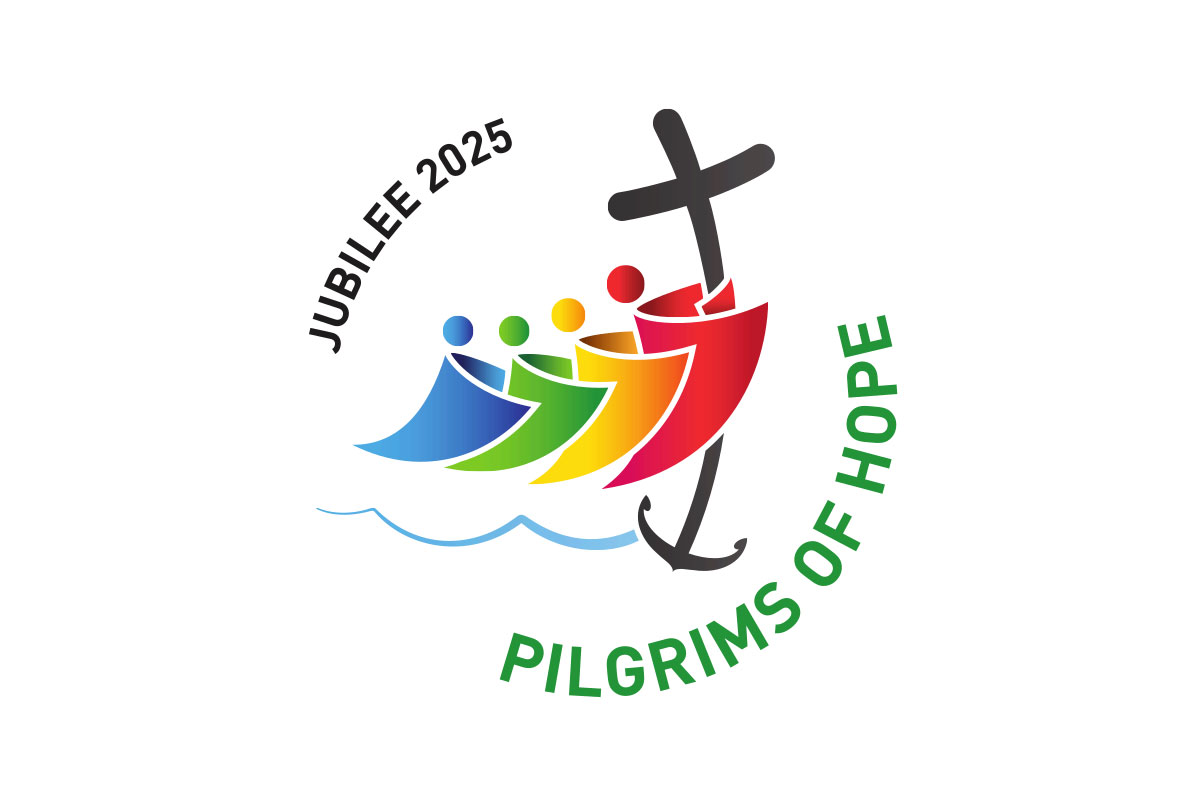
The Jubilee Logo

The logo shows four stylized figures, representing all of humanity, coming from the earth’s four corners. They embrace each other to indicate the solidarity and fraternity which should unite all peoples. The figure at the front is holding onto the cross. It is not only the sign of faith that this lead figure embraces, but also of hope, which can never be abandoned, because we are always in need of hope, especially in our moments of greatest need. There are rough waves under the figures, symbolizing the fact that life’s pilgrimage does not always go smoothly in calm waters. Often the circumstances of daily life and events in the wider world require a greater call to hope. That’s why we should pay special attention to the lower part of the cross which has been elongated and turned into the shape of an anchor which is let down into the waves. The anchor is well-known as a symbol of hope. In maritime jargon, the ‘anchor of hope’ refers to the reserve anchor used by vessels involved in emergency maneuvers to stabilize the ship during storms. It is worth noting that the image illustrates the pilgrim’s journey not as an individual undertaking, but rather as something communal, marked by an increasing dynamism leading one ever closer to the cross. The cross in the logo is by no means static, but it is also dynamic. It bends down towards humanity, not leaving human beings alone, but stretching out to them to offer the certainty of its presence and the security of hope. At the bottom of the logo is the motto of the 2025 Jubilee Year: Peregrinantes in Spem (Pilgrims in Hope), represented in green letters.

YEAR OF PRAYER RESOURCES

Subject: Teach us to pray

Teach Us How to Pray – school programme launched

  • Jan 29th, 2023 Taken for ICN Today

Source: CJM Music

After months of writing, film and editing, CJM has rolled out the first part of the first module of Teach us to Pray – a series of video courses on different aspects of prayer and liturgy in the context of a Catholic school.

This accessible and practical resource draws on more than 25 years of experience working with young people to bring the liturgy to life, while staying deeply rooted in the tradition of the Church.

Jo Boyce writes: “We hope it will help give confidence and inspiration to RE Leads and Lay Chaplains especially, but have designed it to be accessible for all staff who want to contribute meaningfully to the prayer and liturgical life of their schools.

“It’s very much a work in progress, of course. But most of module one is available right now and you get instant access to that when you sign-up at: www.cjmmusic.com/teachustopray

If you’re not directly involved in the life of a Catholic school yourself, it is very likely that you know someone who is. So please pass this information on if you can. And please keep this project in your prayers. It’s a BIG vision, which is calling on A LOT of time and resources.

For more information and to see a video about the programme see: https://cjmmusic.mykajabi.com/teachustopray

Church Unity Week 18 -25 January 24

  • Week of Prayer for Christian Unity 18-25 January 2024

Bishops considered the report on the Irish Inter-Church Meeting of 19-20 October.  This marked the 50th anniversary of the Ballymascanlan Talks in 1973, an event that led to the formation of the IICM, the mechanism through which the Irish Episcopal Conference dialogues with other Churches in Ireland.
 

In addition, bishops also received a report from the Council for Ecumenism on the annual Week of Prayer for Christian Unity which will place 18-15 January 2024, on the theme, ‘You shall love the Lord your God… and your neighbour as yourself’ (Lk 10:27).  Resources for the Week of Prayer have been compiled by the Holy See Dicastery for Promoting Christian Unity and ecumenical bodies in Burkina Faso.  These resources are being forwarded to dioceses and parishes and they are also available on ctbi.org.uk.  Bishops encourage dioceses and parish communities to participate in this Week of Prayer.

Introduction

The parable of the Good Samaritan is one of the best-known passages of Scripture, yet one that never seems to lose its power to challenge indifference to suffering and to inspire solidarity. It is a story about crossing boundaries that calls our attention to the bonds that unite the whole human family.

In choosing this passage of Scripture for the Week of Prayer for Christian Unity, the churches of Burkina Faso have invited us to join them in a process of self-reflection as they consider what it means to love our neighbor amid a security crisis. Communities in the British-Irish context may be less vulnerable to acts of mass violence than in Burkina Faso, but there are still many living with the memory and/or the threat of serious violence, centered on issues of identity and belonging. There are also groups within communities, including people from ethnic minority backgrounds and people seeking asylum, who feel particularly vulnerable to violence or being displaced by the threat of violence.

Download the service below.