“Peace be with all of you!” – the first words of Pope Leo XIV. The Conclave has elected Robert Francis Cardinal Prevost as the 267th Bishop of Rome.
The new pope was announced to the waiting crowds by Cardinal Protodeacon Dominique Mamberti from the central loggia of Saint Peter’s Basilica:
‘Annuntio vobis gaudium: HABEMUS PAPAM Eminentissimum ac reverendissimum Dominum Robertum Franciscum Sanctae Romane Ecclesiae Cardinalem Prevost qui sibi nomen imposuit Leo XIV.’
Pope Leo XIV greeted the city of Rome and the world with these words at his first appearance as the Successor of Peter from the Central Loggia of St Peter’s Basilica:
Peace be with you! Dearest brothers and sisters, this was the first greeting of the risen Christ, the good shepherd who gave His life for the flock of God. I, too, would like this greeting of peace to enter your hearts, to reach your families and all people, wherever they are; and all the peoples, and all the earth: Peace be with you.
This is the peace of the Risen Christ, a disarming and humble and preserving peace. It comes from God. God, who loves all of us, without any limits or conditions. Let us keep in our ears the weak but always brave voice of Pope Francis, who blessed Rome – the Pope who blessed Rome and the world that day on the morning of Easter.
Allow me to continue that same blessing. God loves us, all of us, evil will not prevail. We are all in the hands of God. Without fear, united, hand in hand with God and among ourselves, we will go forward. We are disciples of Christ, Christ goes before us, and the world needs His light. Humanity needs Him like a bridge to reach God and His love. You help us to build bridges with dialogue and encounter so we can all be one people always in peace.
Thank you Pope Francis!
Thank you to my Cardinal brothers who chose me to be the Successor of Peter and to walk together with you as a united Church searching all together for peace and justice, working together as women and men, faithful to Jesus Christ without fear, proclaiming Christ, to be missionaries, faithful to the gospel.
I am a son of Saint Augustine, an Augustinian. He said, “With you I am a Christian, for you a bishop.” So may we all walk together towards that homeland that God has prepared for us.
To the Church of Rome, a special greeting:
We have to look together how to be a missionary Church, building bridges, dialogue, always open to receiving with open arms for everyone, like this square, open to all, to all who need our charity, our presence, dialogue, love.
Hello to all and especially to those of my diocese of Chiclayo in Peru, a loyal, faithful people accompanying the bishop and helping the bishop.
To all you brothers and sisters of Rome, Italy, of all the world, we want to be a synodal church, walking and always seeking peace, charity, closeness, especially to those who are suffering.
Today is the day of the Supplicatio [Plea] to Our Lady of Pompei.
Our blessed mother Mary always wants to walk with us, be close to us, she always wants to help us with her intercession and her love. So let us pray together for this mission, and for all of the Church, and for peace in the world.
We ask for this special grace from Mary, our Mother.
Hail Mary… [accompanied by the crowds in St Peter’s Square and around the world.]
Biography
Cardinal Robert Francis Prevost, OSA, Prefect of the Dicastery for Bishops, Archbishop-Bishop emeritus of Chiclayo, was born on 14 September 1955 in Chicago (Illinois, United States). IN 1977 he entered the novitiate of the Order of Saint Augustine (OSA) in the province of Our Lady of Good Counsel, in Saint Louis. On 29 August 1981 he gave his solemn vows. He studied at the Catholic Theological Union of Chicago, receiving a diploma in theology.
At the age of 27 he was sent by the Order to Rome to study canon law at the Pontifical Saint Thomas Aquinas University (Angelicum). He received priestly ordination on 19 June 1982. He received his licentiate in 1984, and was then sent to work in the mission of Chulucanas, in Piura, Peru (1985-1986).
In 1987 he was awarded a doctorate with the thesis: “The role of the local prior in the Order of Saint Augustine”. In the same year he was elected director of vocations and director of the missions of the Augustinian province of “Mother of Good Counsel” of Olympia Fields, Illinois, United States of America. In 1988 he was sent to the mission of Trujillo as director of the joint formation project for Augustinian aspirants in the Vicariates of Chulucanas, Iquitos and Apurímac. There he served as community prior (1988-1992), director of formation (1988-1998) and teacher of the professed (1992-1998). In the archdiocese of Trujillo he was judicial vicar (1989-1998), and professor of canon, patristic and moral law in the “San Carlos e San Marcelo” Major Seminary.
In 1999 he was elected provincial prior of the “Mother of Good Counsel” province, Chicago. After two and a half years, the ordinary general Chapter elected him prior general, a ministry again entrusted to him in the 2007 ordinary general Chapter. In October 2013 he returned to his province (Chicago) to serve as teacher of the professed and provincial vicar, roles he held 3 November 2014, when Pope Francis appointed him apostolic administrator of the diocese of Chiclayo, Peru, elevating him to the dignity of bishop and assigning him the titular diocese of Sufar. On 7 November he took canonical possession of the diocese in the presence of the apostolic nuncio James Patrick Green; he was ordained a bishop on 12 December, Feast of Our Lady of Guadalupe, in the cathedral of his diocese. He served as bishop of Chiclayo from 26 November 2015. In March 2018 he became second vice president of the Peruvian Episcopal Conference. Pope Francis appointed him a member of the Congregation for the Clergy in 2019, and member of the Congregation for Bishops in 2020.
On 15 April 2020, the Pope appointed him apostolic administrator of the diocese of Callao.
On 30 January 2023 Pope Francis appointed Cardinal Prevost as prefect of the Dicastery for Bishops and presidet of the Pontifical Commission for Latin America.
Created and proclaimed Cardinal by Pope Francis in the Consistory of 30 September 2023, of the Deaconry of Santa Monica.
He was a member of: The Dicasteries for: Evangelization, Section for first evangelization and the new particular Churches; the Doctrine of the Faith; the Eastern Churches; the Clergy; the Institutes of Consecrated Life and the Societies of Apostolic Life; Culture and Education; Legislative Texts; The Pontifical Commission for Vatican City State.
With great joy, I welcome our new Pope Leo XIV. At the end of February I and the other Irish archbishops – Dermot Farrell, Kieran O’Reilly, Francis Duffy – met with him, and he came across as a humble and respectful listener, wanting to learn as much as possible about the Church in Ireland. He is a calm, affable and approachable person. He is a friend of Ireland and no doubt the Augustinian communities at home will be delighted with the news.
Pope Leo is a missionary at heart with a breadth of international experience and background – having ministered in three continents. His opening words about peace and ‘building bridges’ indicate that he wishes to work for reconciliation and unity in the Church and in the world.
Pope Leo’s choice of name suggests that a commitment to Catholic social teaching will be a hallmark of his papacy. Please pray for him. Saint Peter intercede for him. Our Lady of Grace watch over him.
I pray: God bless Pope Leo XIV. Pour out your Holy Spirit upon him with all the graces he needs to be a courageous and gentle shepherd. Fill him with faith, hope and love. May he govern with wisdom and fidelity to Christ and the Gospel. May he be an inspiring missionary of peace, healing and reconciliation in the world. Give him health and strength to do all that you ask of him. Amen.
Tomorrow morning, (Friday, 9 May), at the grotto in Lourdes, France I will use the name of Pope Leo XIV for the first time at Mass and pray for our new pope. I’m here on the Archdiocese pilgrimage and Mass is at 7.30am Irish time available on the Lourdes website: www.lourdes-france.org live at the grotto.
For students to look about Pope Leo’s family and life follow this link
At the age of 88, following serious illness, Good Pope Francis has passed from earthly life to eternity on Easter Monday 2025. He will be most fondly remembered by all who caught his dream of a synodal church – in which every person is conscious of the equal importance of their own life in witnessing to the saving truth of the Gospel.
I loved the Stations of the Cross written by Pope Francis for Good Friday this year
Yesterday a friend sent me this tribute to Pope Francis
Tribute
“A Hindu man, Vinod Sekar, has written one of THE most moving and beautiful tributes ever written for anyone… for the late Pope Francis.”
*The Loss of a Good Man: A Tribute to Pope Francis and the Power of Universal Faith*
I only met Pope Francis once. It was brief. Just a few moments in a crowded room filled with dignitaries and seekers, some out of duty, others out of belief. I was neither Catholic nor there on some divine pilgrimage. I was just a man in need of a little hope. And somehow, in that fleeting encounter, I received it.
It’s hard to explain without sounding overly romantic. Still, when you’re in the presence of someone truly good—not performatively good, not “publicly moral” or selectively kind—but genuinely, deeply, relentlessly good… something shifts in you. You feel lighter. You feel braver. You feel like humanity, for all its wounds and wickedness, is still worth fighting for.
That was the gift Pope Francis gave me. And I imagine, from the tears I’ve seen today and the aching silences of millions across faiths, races, and borders, that he gave that same gift to many.
Today, we mourn not just the passing of a Pope. We mourn the loss of one of the strongest chess pieces humanity had on this plane of existence.
He was a man who made kindness radical again. Who reminded the powerful that humility was not weakness. Who spoke of love not as doctrine but as duty. He was not just a religious man. He was something far more rare — he was universally spiritual.
I am a Hindu. My God wears different names. My prayers come in different rhythms. But I would have followed this man through fire. Because in his belief in God, he carried a belief in all of us. His eyes didn’t see denominations — they saw dignity. His voice, always soft but never weak, carried the weight of truth even when it unsettled the comfortable. Especially when it unsettled the comfortable.
This world has a way of chipping away at your soul. The noise, the greed, the hate, the empty rituals that masquerade as faith or patriotism or family values. It’s easy to go numb. It’s easy to give in to cynicism. But once in a while, someone comes along who reminds us that the better angels of our nature are still within reach. That goodness is still possible. That we don’t need to be perfect to do good — we just need to be brave. Pope Francis was that man.
He chose love over doctrine. He chose compassion over judgment. And most remarkably, he chose action over applause. He walked with the poor. He knelt before the discarded. He challenged the powerful not with anger, but with moral courage. And he did all of this with a smile that felt like a prayer.
He understood something many religious leaders forget: that God doesn’t reside only in temples or churches or mosques. That holiness isn’t a place — it’s a way of living. A way of seeing others. A way of choosing kindness, over and over, even when it hurts.
So yes, today we mourn. I mourn. Not just for the Catholic world, but for all of us. Because when a man like this leaves, it feels like a light has been dimmed.
But maybe — just maybe — the way we honour him is by becoming the light ourselves.
Let us remember his faith in humanity, and let it fuel our own. Let us keep making the right chess moves in this complicated, brutal, beautiful game of life. Let us speak truth with grace. Let us protect the vulnerable, question the powerful, and lift each other up not because of who we are, but because we are here together.
*Pope Francis believed in a world where dignity wasn’t conditional. Where faith was lived, not just preached. That world can still exist — if we build it.*
And maybe that’s the final gift he’s given us. A call not to despair, but to duty.
*Because as long as we carry his belief in each other, then truly, he has not left us at all.*
Vinod Sekhar
Pope Francis wrote a lovely piece on death, which I read yesterday ( Declan )
Death is one more step in life. If you are sure that the Lord will not betray you, then you can go forward with courage. The Lord himself will give you the grace to see life in death. There is an expression that I do not like: “the House of the Father” or “going back to the Father’s House,” as if our life were a round trip. It would be better to say: “Go to meet the Lord” or “I’m going towards that meeting.” There will be a meeting or encounter at the end of life. It’s a meeting I may or may not have had in life and it’s a meeting that I’ve been looking forward to or not looking forward to in my life. But in the end, we will meet God face to face.
Another tribute I came across that resonated with me. Declan
A Pope in a Poncho: The Gospel of Fragility
It was not the papal cassock, the golden cross, or the solemn gaze from a palace balcony that marked April 10, 2025.
Instead, it was a fragile old man in a striped poncho, worn black trousers, and oxygen tubing, rolling quietly through the grandeur of St. Peter’s Basilica.
No proclamation, no camera crews, no ceremonial fanfare. Just a tired pilgrim in the skin of a pope, moving slowly toward the restored chair of Peter and the tomb of Saint Pius X.
To some, it was a scandal. To others, a shock. And to a few—perhaps not many—it was a moment of profound, unscripted holiness.
Because it was not the Vicar of Christ clothed in tradition but something far rarer: a leader without costume, a priest without performance, a man who dared to embody the Gospel in raw, human skin.
In an institution where clothing is language—the cassock, the skullcap, the ring—all speak of office, succession, and sacred continuity—Francis chose a language older than vestments: the language of presence.
In his beige Argentine poncho, he wasn’t signalling authority; he was invoking memory—of his homeland, of the poor, of the Jesus who walked dusty roads with no sceptre, throne, or robe worth envying.
Some saw an older man too frail to dress appropriately. Others saw disrespect for ritual. But to those attuned to the undercurrent, it was something else entirely: a gesture of undoing, the kind that refuses to uphold a performance when the soul is calling for honesty.
He didn’t come to be venerated that day. He came to be.
And in doing so, he reminded the Church—perhaps unintentionally—that the robes, collar, rituals, and relics are only bridges. They are not the water beneath.
When we strip away the grandeur, what remains is a question the Church must confront more often: What happens when the sacred no longer looks impressive? When authority arrives in a wheelchair, with sunken eyes and no cross on its chest?
Whether deliberately or by accident, Francis exposed the quiet truth: the real scandal is not the poncho, but how much we’ve come to rely on appearances to sustain our reverence.
We want our popes upright, glowing, and draped in theology. We don’t want them too human, too frail, too much like us.
But isn’t that precisely the paradox at the heart of Christianity?
*Today, when Jesus rides into Jerusalem on a colt, his official representative on earth is wheelchaired into the most ornate church on earth, dressed in an Argentinian poncho reminded us that fragility is not the opposite of faith—it may be its most honest form.*
That perhaps, in a moment like this, the Church caught a glimpse of what Jesus meant when he knelt to wash feet instead of issuing commands.
This was not the Pope as prince or priest. This was the Pope as a person, as a pilgrim, as a reminder that grace may arrive not dressed in white but in weakness.
And maybe, just maybe, that is the Church we need to become.
Johnson Kotaram
From the editorial of this weeks Tablet Journal
Let us Dream is also the title of the wonderful little book Pope Francis wrote in 2020, during the months of lockdown, with the English Catholic writer, papal biographer and former deputy editor of The Tablet, Austen Ivereigh. “I never imagined I would grow close to a pope, of all people, and can’t quite describe what the relationship was. I sometimes see myself in the media described as his friend, but that can’t be right. He was a master and a father and a loving guide, the greatest teacher of the Gospel of Jesus Christ I have known, and I was blessed that he cared for me, as he cared for everyone,” Austen writes in this week’s special issue. He last met Francis in December. “He seemed exhausted, and short of breath. I got out my recorder and asked him questions, as usual, but his voice was raspy and the answers perfunctory. So I turned it off, and said I had no more questions. ‘That’s OK,’ he said. ‘I’m just glad you’re here. Tell me what’s been happening.’ So we spoke of this and that, and we chatted, heart to heart. When he looked tired, I got up to leave. We hugged. As I left, sensing it might be the last time, it hit me how much I would miss him, what a hole he would leave. By the time the lift reached the ground floor, I was in tears.” Some of us were in tears, too, when we read Austen’s piece. Brendan Walsh
“Right up to his very last day,” Julian Paparella writes in his View from Rome, “Francis put into practice what he characterised on countless occasions as the ‘style of God’: closeness, tenderness, and compassion … This pontificate has been a new springtime of renewal in the Church; his point was not to see it all through to completion, but to open up new pathways forwards. To quote the well-known prayer associated with Archbishop Oscar Romero whom Francis canonised, he was ‘a prophet of a future not his own’.”
As a subscriber to the weekly Tablet I am always impressed by the quality of Journalism and the angles taken in reinforcing the insights and reforms established by the Second Vatican Council. I warmly recommend it to teachers to keep you informed and to assist you in keeping updated and grounded in contemporary spiritual and ethical issues Declan
Archbishop Eamon Martin Speaks on the Death of Pope Francis
“There was something different about this pope who came to us twelve years ago from “the ends of the world”. On that very first night when he stood on the balcony of Saint Peter’s Basilica, our hearts were moved as he greeted the people with a simple ‘Buonasera’ and asked us to pray to the Lord to bless him.”
On hearing today the announcement that Pope Francis has died, my heart is filled with both deep sadness and immense gratitude, as we say farewell to a faithful shepherd who has walked closely with his people and carried their joys and sorrows in his heart.
Pope Francis’ papacy has been a profound gift to the Church and World. On behalf of the Irish Bishops’ Conference, and the Catholic faithful on the island of Ireland, I extend sympathy to Pope Francis’ family members, to those who have worked most closely with him, and to all those around the globe who loved him and will mourn his loss.
There was something different about this pope who came to us twelve years ago from “the ends of the world”. On that very first night when he stood on the balcony of Saint Peter’s Basilica, our hearts were moved as he greeted the people with a simple ‘Buonasera’ and asked us to pray to the Lord to bless him. Now we pray to that same Lord to show him mercy and welcome him to his eternal reward. Pope Francis often expressed his personal unworthiness, insisting ‘I am a sinner’. He would want us to pray now for his soul as he appears before God whom he himself presented to the world as a loving and merciful God, who understands all our weaknesses and frailties, yet loves each of us deeply.
The Catholic people of the world will mourn the loss of the late ‘holy father’, while thanking God for his tireless service as priest and bishop, and his courageous witness as servant leader of the Catholic Church. Pope Francis embodied a Church that listens, accompanies, and embraces all. His vision was not one of rigid structures or distant authority, but of a Church committed to encounter and deep solidarity with humanity. Grounded and shaped by the Latin American Theology of the People (Teología del Pueblo), Pope Francis recognised the wisdom of ordinary believers, affirmed the beauty of popular devotion, and upheld the dignity of those on the margins of both the Church and society.
From the very first days of Pope Francis’ pontificate in 2013, he had a special place in his heart for the poor, those often forgotten on the peripheries, and those who are suffering most – both globally and locally. He showed us by word – and action – that solidarity with the poor and vulnerable means looking into their faces, touching their flesh, sensing their closeness and trying to help them. Such solidarity never tolerates any assault on human life or on the human dignity of any person.
Pope Francis’ bold gestures of compassion spoke to millions across the globe – from his sincere empathy for migrants and outreach to prisoners, to his humble avoidance of many of the traditional privileges and accoutrements of the papacy.
Pope Francis was not just a leader of Catholics, or even of Christians; rather, he was a global leader who spoke with much needed balance and authority on behalf of countless people of goodwill around the world. He went the extra mile in reaching out to those of other Christian denominations and world faiths. He built friendships across religious divides because he firmly believed that we are all brothers and sisters. He abhorred war as a ‘defeat for humanity’ and he continuously advocated for peace building, reconciliation and cooperation between peoples, faiths and nations in our very troubled world.
For someone who took up such a challenging role at the age of 76, Pope Francis appeared happy and youthful and, until recently, he seemed to have boundless energy! He never lost a minute in promoting the Good News of Christ to children, young people, parents and the elderly all over the world, travelling to many faraway places to bring the joy of the Gospel.
At the Vatican, he insisted on reform of the Curia and of the global Church’s safeguarding procedures, courageously confronting the terrible sins and crimes of abuse in the Church and its traumatic impact on victims, survivors and the wider faithful.
In choosing the name Francis, he set himself the demanding task of following in the footsteps of the great saint of Assisi – modelling a preferential option for the poor, building peace and friendship everywhere, and highlighting the urgent need for the care and protection of God’s creation. He alerted the entire world to the ‘cry of the Earth’ and the ‘cry of the poor’, emphasising that all creatures are connected by the love of the Creator; he constantly highlighted the imperative facing humanity of caring for our common home and protecting the gifts of creation for future generations.
Here in Ireland we will always remember that Pope Francis made time to visit us when the World Meeting of Families was held in Dublin in 2018. He brought us a message of encouragement and consolation, stressing the fundamental importance of family and marriage for society and for the Church. But even in that hectic, short visit he emphasised the importance of ‘encounter’- meeting with the homeless and hungry at the Capuchin Day Centre, conversing with couples preparing for marriage, and travelling to Knock to pray with, and for, the people of Ireland. Most importantly, however, he wanted to take time to listen and respond to the heartfelt, painful stories of survivors of abuse.
No doubt in the coming days and weeks many more memories of Pope Francis will emerge, but for me it was his closeness and friendship with Christ which stood out most of all – in his compassion for the suffering, and the way he placed the vulnerable at the centre of his ministry – the poor, refugees, victims of war, human trafficking, and all who are exploited, overlooked or excluded by Church or by society. He wanted to bring them in from the cold.
As a leader, Pope Francis continually emphasised the importance of listening and discernment, calling the Catholic Church to be a ‘synodal Church on mission’. He wanted everything in the Church to be put in what he called ‘a missionary key’. The Church cannot be shut up in the Sacristy; it should neither come across as a dusty museum, nor, on the other hand, as some kind of NGO. The Church is a home for the lost and wounded. Like a ‘field hospital’, it is entrusted with the task of welcoming the sinner with tenderness and mercy, and presenting the joyful message of salvation in Christ. This, he said, impels her to go out and spread the Good News, accompanying and calling people back to the person that God wants them to be. Now, as Pope Francis goes to God, it is up to us to continue to make known that ‘God loves us first’, and that we in turn are called to love one another as brothers and sisters who know that Christ is alive; Christ is our hope!
In his 2020 encyclical Fratelli Tutti, on fratenity and social friendship, Pope Francis posed a series of ‘real’ questions for leaders to reflect upon, such as: ‘How much love did I put into my work?’; ‘What did I do for the progress of our people?’; ‘What mark did I leave on the life of society?’; ‘What real bonds did I create?’; ‘What positive forces did I unleash?’; ‘How much social peace did I sow?’; and, ‘What good did I achieve in the position that was entrusted to me?’.
No doubt he often put these same questions to himself.
It is my hope and prayer that our loving and merciful God shall give Pope Francis the answer to those questions today: ‘You did well, Francis; well done, good and faithful servant.’
At the outset of his Petrine ministry, Pope Francis urged us in his 2013 Apostolic Exhortation, Evangelii Gaudium (The Joy of the Gospel, (86)): ‘Do not let yourselves be robbed of hope.’ May his legacy continue to bear fruit in a Church that listens, serves, and dares to dream.
Pope Francis, thank you.
Sacred Heart of Jesus, have mercy on his soul.
Amen.
+ Archbishop Eamon Martin
Archbishop of Armagh, Primate of All Ireland
Catholic educators respond to death of Pope Francis
Following the death of Pope Francis on 21 April 2025, the Ireland’s Catholic Education Partnership published the following statement:
It was with profound sadness that the Board of Catholic Education Partnership (CEP) learnt of the death of Pope Francis. Our prayers are joined with that of our brothers and sisters in faith throughout the world that Jesus Christ may grant Pope Francis rest in the House of the Father.
Dr Marie Griffin, chairperson of CEP, said, “Catholic educators remember Pope Francis with gratitude and fondness for his leadership and inspiration. In the Global Compact on Education he gave us a pathway to compassionate care and respect for all, especially the marginalised. In it, he drew our attention to the twin ecological challenges of our age: the ecological crisis of our common home and that of the ecology of the human person. In it, he placed families and the human person at the centre of concern for educators, emphasising the need to listen to the voices of the young and to find new ways of understanding economics, politics, growth and progress. In time, I am confident that this will be seen as a key aspect of the rich legacy of his pontificate.”
The Chief Executive of CEP, Alan Hynes, noted, “that the last message on social media posted by Pope Francis reminded us that the resurrection of Christ captures ‘the entire meaning of our existence, for we were not made for death, but for life’. This is the Golden Thread running through Catholic education – that human life has a meaning, purpose, and destiny, far beyond the limitations of this mortal life.
“Time and time again, Pope Francis drew attention to the significance of human dignity, made as we are in the image of God. In Fratelli Tutti he reminds us that ‘as a community, we have an obligation to ensure that every person lives with dignity and has sufficient opportunities for his or her integral development.’ These words serve as a mission statement for Catholic education, words that we will seek to honour as we continue on with our work in the light of Pope Francis’ profound legacy to the Church and to the world.”
The Catholic Education Partnership was established in 2020 and replaced the Catholic Schools Partnership. The purpose of the CEP is to provide an authoritative and unified voice for the Catholic education sector at primary, post-primary and tertiary levels on the island of Ireland.
The Bishops’ Communications Office in Maynooth has made available digital Books of Condolence for people to record their sympathy and these are available on the homepage of catholicbishops.ie, on the bishops’ social media platforms of Facebook, Instragram, X, Linkedin and on BlueSky.
Pope Francis: Lent calls us to journey together in hope Source: Vatican Media
In his Message for Lent 2025, Pope Francis invites the faithful to “journey together in hope,” and to take the opportunity of the upcoming Lenten Season to ask ourselves whether we are truly willing to heed God’s call to change our lives.
The Pope’s reflection, which ties into the broader theme of the Jubilee Year: ‘Pilgrims of Hope‘ focuses on conversion and unfolds in three key dimensions: the importance of journeying, journeying together, and journeying with hope.
Recalling the biblical Exodus of the people of Israel from Egypt to the Promised Land, the Pope reminds us that our lives too are a journey-one that should be directed toward God.
This journey is not merely a metaphorical one but involves a constant call to conversion, “to leave behind the occasions of sin” and situations that degrade our human dignity.
Pope Francis, therefore, urges the faithful during this Lenten Season to examine their own lives: are they actively progressing on the path of spiritual renewal or are they held back by fear and hopelessness or reluctant to move out of their comfort zone?
Drawing a parallel between the Hebrew people’s “arduous path from slavery to freedom” and the plight of modern migrants and refugees, the Pope invites us to use this period as an opportunity to consider how we relate our own lives with the struggles of those who are forced to flee “situations of misery and violence in search of a better life” and “in this way discover what God is asking of us.” This, he writes, “would be a good ‘examination of conscience’ for all of us wayfarers.”
“It is hard to think of the biblical exodus without also thinking of those of our brothers and sisters who in our own day are fleeing situations of misery and violence in search of a better life for themselves and their loved ones. A first call to conversion thus comes from the realization that all of us are pilgrims in this life.”
A fundamental aspect of the Lenten Message is the emphasis on community and synodality-the idea that Christians must walk together rather than in isolation.
Pope Francis reminds us, “The Holy Spirit impels us not to remain self-absorbed, but to keep walking towards God and our brothers and sisters.”
“Journeying together,” he writes, “means consolidating the unity grounded in our common dignity as children of God (…) without letting anyone be left behind or excluded.”
Again, he challenges the faithful to reflect on whether we are capable of walking together with others in our families, workplaces, and communities, resisting the temptation to become self-absorbed. Are we welcoming to others? Do we include those who feel marginalized?
“Let us ask ourselves in the presence of the Lord whether, as bishops, priests, consecrated persons and laity in the service of the Kingdom of God, we cooperate with others. Whether we show ourselves welcoming, with concrete gestures, to those both near and far. Whether we make others feel a part of the community or keep them at a distance.”
The third fundamental dimension of the Lenten journey is hope, anchored in God’s promise of salvation and eternal life fulfilled in Jesus’ Resurrection, the victory over sin and death.
This hope is not abstract but must be lived concretely. Pope Francis invites us to examine whether we truly trust in God’s mercy. Do we believe in His forgiveness, or do we fall into the trap of self-reliance? And do we concretely experience the hope that inspires in us “a commitment to justice and fraternity, to care for our common home and in such a way that no one feels excluded?”
Quoting Saint Teresa of Avila, the message urges the faithful to remain watchful and patient, understanding that God’s promises will be fulfilled in His time.
“This was the prayer of Saint Teresa of Avila: ‘Hope, O my soul, hope. You know neither the day nor the hour. Watch carefully, for everything passes quickly, even though your impatience makes doubtful what is certain, and turns a very short time into a long one.'” Pope concludes by entrusting this journey of hope to the intercession of the Virgin Mary, “Mother of Hope,” praying that she may accompany the faithful as we prepare to celebrate the joy of Easter.
Below are Lectio Resource Pages for Taize Prayer this Lent
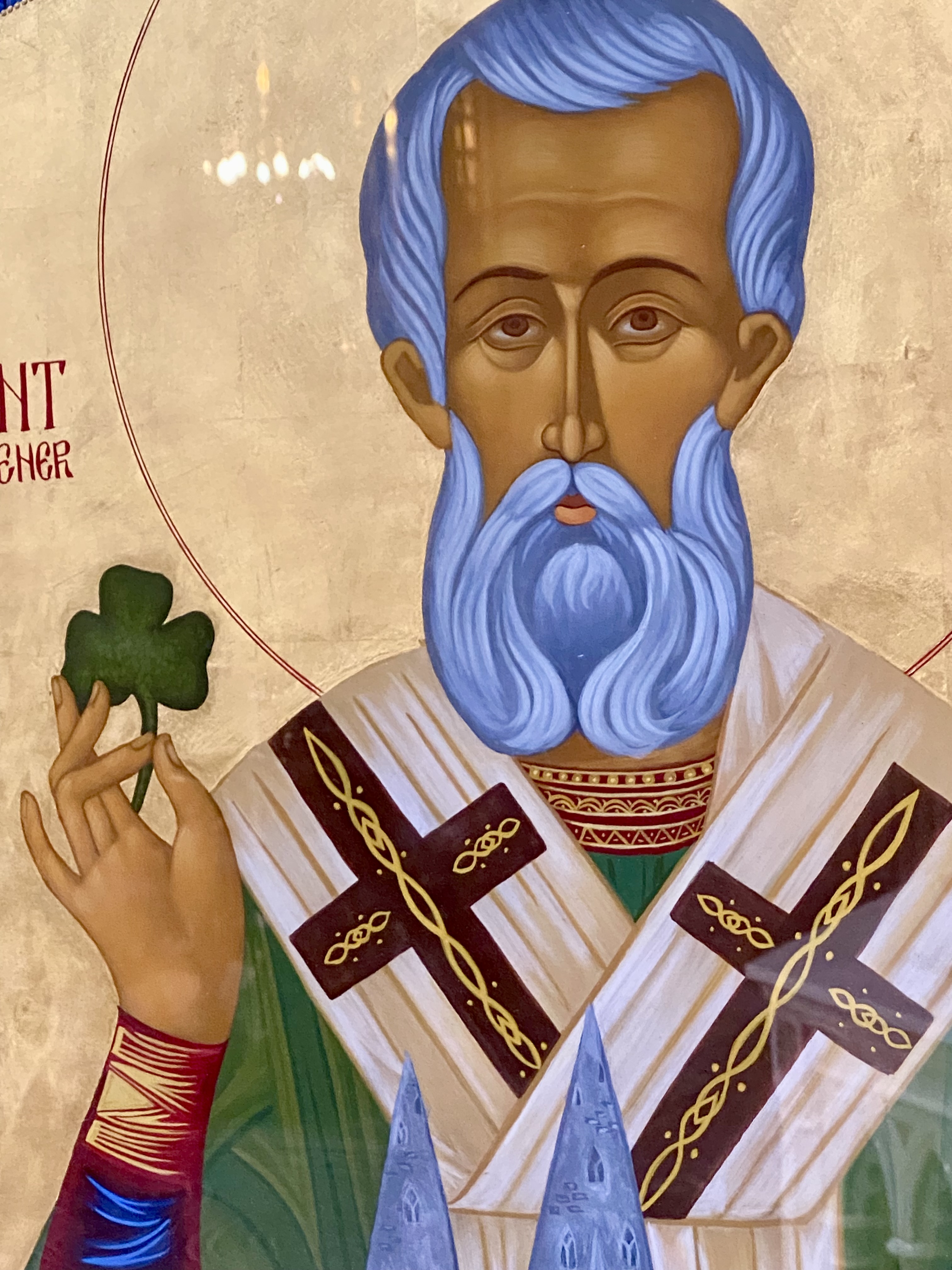
I was delighted to be invited to view and write a short appreciation of this commissioned Icon of St Patrick on the 150th Anniversary of the Armagh Cathedral that bears his name. Icons are a way that God uses to reach out and draw us into Himself Christians have venerated this unique presence by anointing icons with Holy Chrism and praying with and through them as sources of blessing and grace. Hence they are usually placed with a burning lamp or candle and incensed on special occasions.
To pray with an icon is to be united with God as Father Son and Holy Spirit. It is to venerate those millions of disciples who in faithfulness have shared God’s Love and the Gospel message we call the Good News. Patrick was a Christian disciple who during his years as a slave in captivity learned to relate at a very deep mystical level with God as Trinity during his time on Slemish Mountain and the surrounding landscape His isolation and silence taught him to turn to his God as the Desert Fathers and mothers practiced in their isolated hermitages in Syria and the Arabian deserts. Mysticism is the gift of the community we know as God.
Patrick became a deeply committed Trinitarian and this led him to priesthood and later ministry as a bishop; to the very people who had enslaved him and taken him to a foreign land. We know from his writings both his Confessions and letter to Coroticus that Patrick was indeed fully attuned to the similar path being at that time explored in the Middle East the cradle of the Church Filled with zeal for God like Patrick these souls lived austere lives praying the gospels and using disciplines like the Jesus Prayer as a means to enter the circle of life and love God enjoys as Father Son and Holy Spirit.
In this icon Patrick is shown holding the Cathedral a symbol of the See or Church of Armagh As its first bishop and founder it is appropriate he holds it in support and surrounds it with his prayer and protection. Patrick is wearing the pallium that special collar woven from the wool of lambs and kept by the tomb of Peter to be bestowed on every Archbishop reminding them and God’s holy people of our close link to the church of Peter and the Apostles. their mission or task was and is to share and live the Gospel as taught by and lived by Jesus our Saviour and Master
Above the main figure of Patrick we are shown two more important patron saints of the Armagh Church, St Brigid of Faughart ( Mhuire na nGael) baptized herself by Patrick and also St Malachy who in his turn reformed the whole Irish Church and united it with fresh vigor to the See of Peter in Rome. These patron saints together with St Oliver Plunkett are depicted on either side of Jesus on the present High Altar in the Cathedral,. In Patrick’s right hand, we find his great reputed teaching aid the sprig of green shamrock. With it’s three leaves but one stem. Three persons but one God.
The God of Christianity although in continuity with the Hebrew God is radically a Community of equal but distinct persons. “ The Father and I are one “ Unthinkable to Jews yet revealed by Jesus as the core of all life here and in heaven. The intimacy He shows with The Father is amazing and inspires Christians to pursue a similar bond by living daily the spirit of the Beatitudes. Those early desert-dwelling mothers and fathers thirsted for ways to live intimately in the love the Father shared with the Son and Holy Spirit. “To see Me is to have seen Him. “ This was the new Way. The Magi returned home in a new Way prefiguring a whole upturning in our knowledge of God. Jesus tells us He is “The Way, the Truth and the Life “ He lived this bond to the Father as easily as breathing air.
We know Patrick shared this desire to know and love God and he longed to share this with all he encountered. Patrick was familiar with the great teachers of prayer. Anthony of Egypt, John Cassian, and other greats of the desert shared their knowledge and teaching. We can sometimes be surprised at how fast the Good News was shared and how far it traveled. From Egypt and Syria to the Skelligs! This Trinitarian Faith spread all around the Mediterranean coastline moving ever farther through Italy, Gaul, and Spain and it was Patrick who was the main instrument the Father used to draw the Irish peoples of the time to a new radical vision of eternal life and its prospects. “Where I am you too will be “ What hope and what life these words offer to us. Today as then, Patrick calls us all to unite in praise for this Community of God whose living Heart yearns for each of us to step into their life of love. “ I bind unto myself today the strong Name of the Trinity, By invocation of the same, The Three in One and One in Three. “ Each of us today must embrace these words and live our Trinitarian Faith aware of and living the relationship they offer us daily. Each morning like Patrick let us step into their circle of love embracing and taking ownership of the space they have left us to complete so that when we step from this life we will behold their faces and share in their life of love I pray you may be indeed embraced by God as you gaze at and pray before this most holy Icon. St Patrick pray for us. Amen.
Declan O’Loughlin. July 2023
BLESSING SHAMROCK
Heavenly Father. We gather today to celebrate the life and ministry of Patrick, your servant. We ask you to bless these shamrock plants, our national symbol used by Patrick in his ministry to our ancestors, You are truly one God and Three Persons, a Trinity of love and compassion. Through wearing and having these blessed symbols in our homes this day may we be reminded that your Most Holy Trinity watches over and blesses our daily lives. And so now as we sprinkle these shamrock plants with holy water may you bless them † in the name of the Father, creator of all, in the name of the Son, your Word made flesh and in the name of the Holy Spirit who consoles us and reminds us of your love for us, one God forever and ever Amen.
The Council for Catechetics assisting the Council for Education of the Irish Episcopal Conference has published a new document called Wellbeing and the Catholic School for primary and post-primary Catholic Schools. Drawing inspiration from both Christian teachings and governmental strategies, the document highlights how Catholic schools create environments that foster resilience, hope, and moral integrity, ensuring students thrive not just academically but as whole individuals. This resource offers practical insights for school leaders, teachers, and parents to embed a Catholic vision of wellbeing into policies, curriculum, and daily practices. The document is available online here:
Archbishop Eamon recently spoke of the Jubilee Year of Hope: ” There couldn’t be a better time for a Jubilee Year of Hope! We live in a world where anxiety, doubt, and sometimes even despair often appear to have the upper hand. It is sad that so many people go through life without realizing in a personal way that God loves them as they are. Others find it difficult to believe in hope and love because of the present state of the world – surrounded as we are by so much war, violence, exploitation and displacement of people, human trafficking, and attacks on human dignity and life. All the more reason, however, for us who believe – especially clergy and religious – to be fearless ambassadors of faith and hope; energetic peacemakers and supporters of the cause of all human life; carers for the sick and those with disabilities; consolers of the lonely and the bereaved; faithful stewards and protectors of the environment and all God’s creation; generous helpers of the poor, the homeless and the marginalized; and welcoming friends for migrants and refugees.
When Pope Francis announced the Jubilee Year for 2025, he invited us to become ‘pilgrims of hope’. He reminded us of the words of Saint Paul who said, “hope (in Christ) does not disappoint”.
I pray that during this Jubilee Year 2025 there will be many graced opportunities for you personally, and for all the people of the Archdiocese of Armagh, to grow in their personal friendship with Jesus Christ who is our reason for living and our reason for hoping.
Archbishop Eamon Martin concelebrated a special Mass to launch Jubilee Year 2025 for the Archdiocese of Armagh. A Jubilee Year is celebrated every twenty-five years by the worldwide Church during which Catholics come together to rejoice in the faith. Over the Jubilee Year we will be encouraged to show mercy, forgive past wrongs, relieve debt, to spiritually rejuvenate, and be offered an opportunity to recieve a plenary indulgence.
The Mass brought together clergy, families, and young people from parishes across the Archdiocese, as well as His Excellency Archbishop Luis Mariano Montemayor, the Apostolic Nuncio to Ireland. In his homily Archbishop Martin, who presided over the Mass alongside auxiliary Bishop Michael Router, emphasised the importance of hope. Archbishop Martin said, “There couldn’t be a better time for a Jubilee Year of Hope. We live in a world where anxiety, doubt and despair often appear to have an upper hand.” The Primate reflected on the words of Pope Francis, who calls on all believers to be “fearless ambassadors of faith and hope.”
Jubilee Year 2025 will be marked by numerous spiritual events and activities at parish, diocesan, and national levels, including: – Pilgrimages to local and national shrines; – Monthly parish initiatives promoting prayer and reflection; and, – Celebrations of key anniversaries, including the 400th anniversary of Saint Oliver Plunkett’s birth, and the centenary of Venerable Matt Talbot’s death.
In addition to the Jubilee 2025 celebrations, Archbishop Martin announced that year-long preparationswill begin for a Diocesan Congress on Youth and Family Ministry, scheduled for March 2026. This Congress will focus on fostering vibrant youth and family ministry at local levels, engaging parishes, schools, and third level institutions in this important journey of reflection.
Bishop Router spoke about the significance of the Congress, which will build on insights from the Archdiocese’s synodal journey over the last three-years. He said, “Over the coming months, parishes and schools will select delegates to represent them, ensuring broad participation in order to shape the future of youth and family ministry in the Archdiocese of Armagh.”
Archbishop Martin concluded, “As the Jubilee Year’s theme suggests, during 2025 we are all invited to be pilgrims of hope in our daily lives, renewing our commitment to faith, love, and service. Let us journey together in prayer and action, united by the hope we find in Christ.”
Some great school resources about the Jubilee Year are available from CAFOD
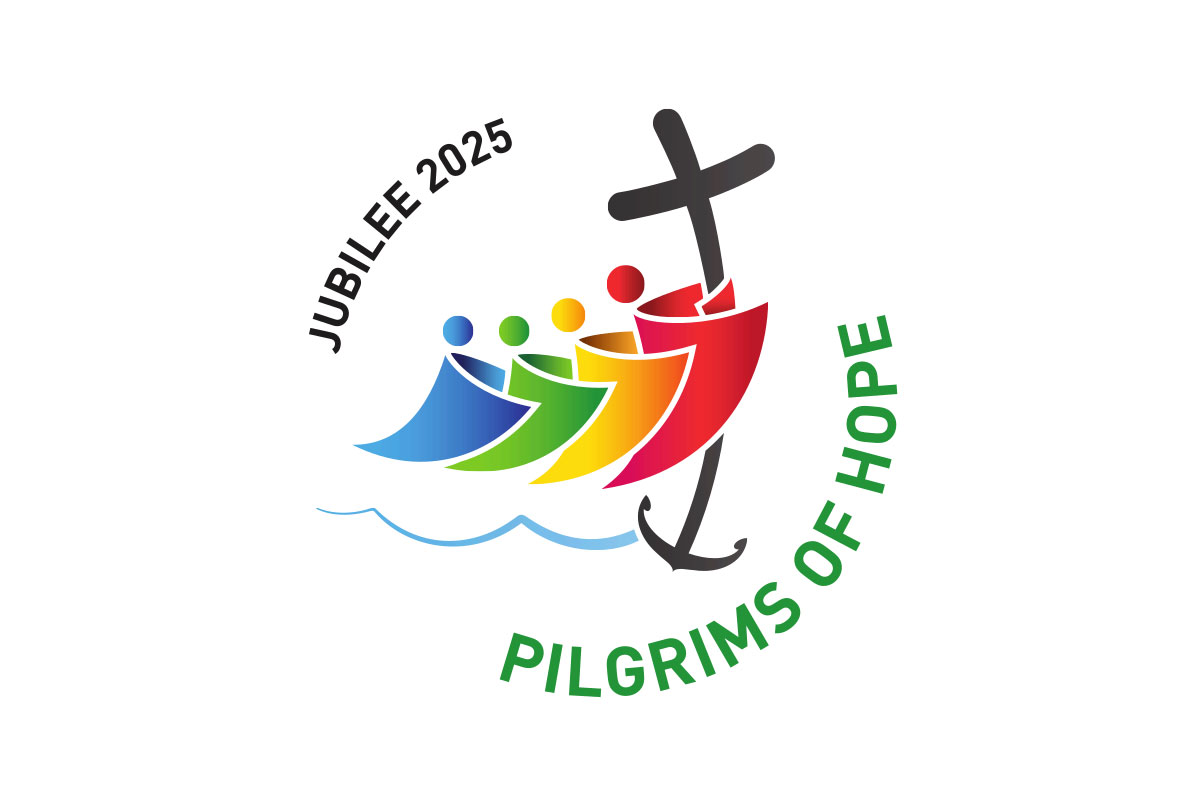
The logo shows four stylized figures, representing all of humanity, coming from the earth’s four corners. They embrace each other to indicate the solidarity and fraternity which should unite all peoples. The figure at the front is holding onto the cross. It is not only the sign of faith that this lead figure embraces, but also of hope, which can never be abandoned, because we are always in need of hope, especially in our moments of greatest need. There are rough waves under the figures, symbolizing the fact that life’s pilgrimage does not always go smoothly in calm waters. Often the circumstances of daily life and events in the wider world require a greater call to hope. That’s why we should pay special attention to the lower part of the cross which has been elongated and turned into the shape of an anchor which is let down into the waves. The anchor is well-known as a symbol of hope. In maritime jargon, the ‘anchor of hope’ refers to the reserve anchor used by vessels involved in emergency maneuvers to stabilize the ship during storms. It is worth noting that the image illustrates the pilgrim’s journey not as an individual undertaking, but rather as something communal, marked by an increasing dynamism leading one ever closer to the cross. The cross in the logo is by no means static, but it is also dynamic. It bends down towards humanity, not leaving human beings alone, but stretching out to them to offer the certainty of its presence and the security of hope. At the bottom of the logo is the motto of the 2025 Jubilee Year: Peregrinantes in Spem (Pilgrims in Hope), represented in green letters.
Our online Advent calendar of daily prayer and reflection will offer an opportunity to pause, reflect, pray and take action as we prepare for Christmas.
Join us as we journey through the season of Advent with our global family.
Sign up for daily reflections straight to your inbox
Our Advent calendar emails offer daily prayers and reflections through your Advent journey, alongside information about ways in which you and the wider CAFOD family can support our ongoing activities.
The daily emails start on the first day of Advent and end on Christmas Day. This email subscription also auto-renews for succeeding Advent seasons, but you can unsubscribe at any time.
Be part of this journey by signing up now for CAFOD’s Advent calendar email reflections.
For 2025, materials were prepared by the ecumenical community at Bose in Northern Italy.As we celebrate 1,700 years since the Council of Nicaea, the worship service has at its heart, the Nicene Creed. Reflecting this, the scripture readings for this year focus on belief. We are invited to reflect on the story of Martha’s confession of faith in Jesus as narrated in John 11:17-27. Each is called to sit with Jesus’ provocative question to Martha: “Do you believe this?”
Resources
For 2025, we are making the resources available both as downloads and printed versions that can be ordered. Download or order resources
Dates: The Week of Prayer for Christian Unity is traditionally observed from the 18th to the 25th January – the octave of St. Peter and St. Paul.
The theme for Catholic Schools Week 2025 is Catholic Schools: Alive in Christ. As we look forward to celebrating Catholic Schools Week 2025, the month of November offers us a moment to remember and pray for the Holy Souls. In November we remember and pray for those who died hoping in the promise of the resurrection. We also pray for the happy repose of the souls of all of our loved ones who have gone before us. During the hustle and bustle of school life, this resource gives schools the time and space to remember that the sorrow of death will give way to Christ’s promise of eternal life with God.
“Christ is alive! He is our hope, and in a wonderful way, he brings youth to our world, and everything he touches becomes young, new, full of life. The very first words, then, that I would like to say to every young Christian are these: Christ is alive and he wants you to be alive!” – Pope Francis, Christus Vivit, Section 1.
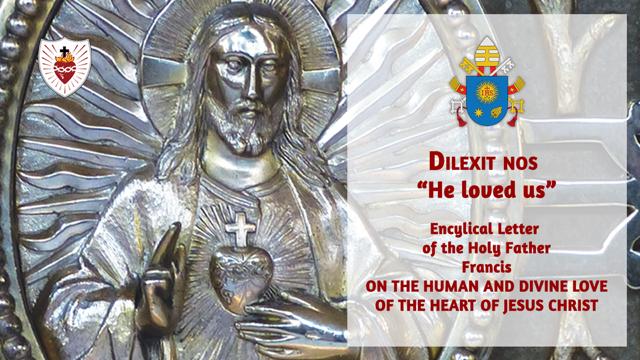
“Dilexit nos – He loved us” – Encyclical of Pope Francis
Prayers and Reflections based on “the Human and the Divine Love of the Heart of Jesus Christ” are available on www.pioneers.ie
Information note for parish newsletter editors:
These prayers and reflections will launch on 1 November 2024.
They have been prepared for
Pioneers, Parish groups
Families,
Religion Teachers (Primary & Secondary)
University Chaplaincies,
AA / NA groups
Two versions of 16 x 9 image for Parish websites is also included
If you wish to be notified of updates, please contact prayer@pioneers.ie
NATIONAL RESOURCES FOR CSW 25 Click on links to access and download
Irish Bishop: Catholic schools follow the example of Jesus, serving all regardless of faith, creed or social background
Jan 18th, 2025 ICN Article
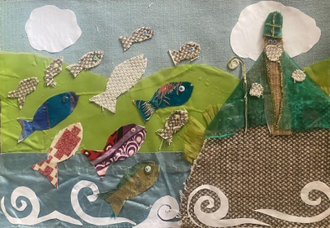
‘Saint Patrick on Croagh Patrick’ artwork created by Explorer’s Class in Knockrooskey National School, Westport, Co Mayo, for 2024 Catholic Primary Schools Management Association competition: Irelands Got Saints!
Source: Irish Catholic Media Office
Across the island of Ireland, from tomorrow, Sunday 19 to Saturday 25 January, the annual celebration of Catholic Schools Week will be marked by parish communities. During this dedicated week, school communities will pray, explore and discuss the 2025 theme Alive in Christ!
Next week, on each day of Catholic Schools Week, there will be a specific thematic focus: Service in Our Community of Friends; Service in Our School Community; Service in Our Family Community; Service in Our Local Community; and, Service in Our Faith Community.”
Bishop Tom Deenihan, Bishop of Meath and chair of the Council for Education of the Irish Catholic Bishops’ Conference, said, “Grounded in the dedication to service of their communities, Catholic schools continue to set a high standard in the provisions of education.
“This is the result of the dedication of all in the school community: pupils, parents, staff, parishes, and those who volunteer to serve on Boards of Management. Christ the Teacher provides the example and sign of what it is to be fully human, to be fully alive, and our schools endeavour to model the education that they provide on this example.
“Generations of people have benefited from Catholic schools and our society is all the better for their contribution to the common good. Our schools, following the example of Jesus, serve every person regardless of creed, background, faith, social status or age,” he said.
During this special week, Catholic schools will explore the meaning of Pope Francis’ introduction to Christus Vivit, “Christ is alive! He is our hope, and in a wonderful way he brings youth to our world, and everything he touches becomes young, new, full of life.” This year’s theme complements Jubilee 2025, where Pope Francis calls on Catholics to be ‘Pilgrims of Hope’, contemplating what it means to be fully alive as a human being – living life to the full in Christ.
Sensitive to the age-appropriateness of the various classes and years, the CSW theme will explore how we exist for one another in Christ, building from the wellbeing of the individual, extending the notion of true wellbeing to others, to our families and communities, and to the Other, in God. The 2025 theme will mediate on hope, the true purpose and meaning of human life, and, in the more senior years, on true freedom. The theme connects with Grandparents’ Day next Wednesday during Catholic Schools Week, and correspondingly with the subject of family in schools at post-primary level.
Each day’s CSW resources offers scriptural reflection on prayer, action, student voice, and concern for our common home, and these are available HERE.




 RE SOURCE