Catholic education is faith-filled, inspiring students to believe in themselves

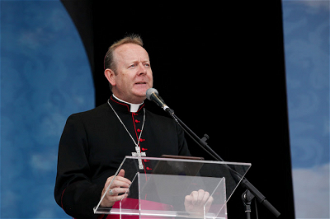
Address by Archbishop Eamon Martin at the graduation ceremony in College Chapel of Saint Patrick’s Pontifical University, Maynooth

  •  “I am immensely grateful for the huge contribution that so many people continue to make to faith-based education in this country” 
  • “A faith-based educational community is not an “I” or a “me”, but an “us” and a “we”, where State and Church seek “to converge” in order to provide the very best opportunities for our young people, serving the common good.”
  • “The Catholic Church does not wish to have any type of monopoly on education, and we encourage all those eligible to participate in the Department of Education survey.  At the same time we value highly the contribution of faith-based education.  We agree with Pope Leo that Catholic education is an act of hope, and a labour of love, handed down from generation to generation.  It is one of the highest expressions of Christian charity, and something which draws new maps of hope for the world at this troubled time.”

Address by Archbishop Martin 
Last week in Rome, Pope Leo XIV marked the Jubilee of the World of Education. He was joined by many thousands of students and educators from all around the world. A special bonus for those who had travelled was to witness Pope Leo conferring the title of “Doctor of the Church,” on Saint John Henry Newman, and naming him as co-patron of Catholic education and educators, alongside Saint Thomas Aquinas.

Some of my most uplifting pastoral moments recently have been connected with the world of Catholic education.  I am immensely grateful for the huge contribution that so many people continue to make to faith-based education in this country: from parents, teachers and special needs assistants in our nursery, primary and secondary schools, to the distinguished professors and lecturers who contribute to Catholic education at third level communities such as this Pontifical University – not forgetting, of course, the huge number of others who contribute to what Pope Leo calls the “constellation of education“.

Pope Leo uses that beautiful image in a new document about education, written specially for this Jubilee Year, with the wonderful title: Drawing new maps of Hope.

Catholic education is a living network, a faith-filled family of schools, colleges, universities and institutes of higher education – each one a ‘star’ in the constellation of education.  Together, Pope Leo says, we in Catholic education ‘chart a course’; we draw “new maps of Hope” for young people in our troubled world.

I have seen this in my recent visits, for example to the brand-new Saint Ronan’s College for 1750 young people in Lurgan, Co Armagh.  I was invited to bless and dedicate the chapel to be the beating heart of their school community.  And, just two days ago, I met with Religious Education coordinators from our primary schools in Dundalk.  They amazed me with their enthusiasm, not only to impart knowledge and understanding of religion, but also to help guide the spiritual and faith development of their young pupils.

A real highlight for me recently was the opening of the Year Mass in Saint Patrick’s Cathedral, Armagh, for the entire school community of Saint Catherine’s College – we reflected on how, in the midst of this frenetic and complicated world, it is essential to find spaces and moments for silence, for reflection, meditation and prayer, to raise our gaze to the transcendent God who created us in love.

I had a similar experience in September right here in this magnificent College Chapel when we conferred an honorary doctorate on Sister Orla Tracey, an Irish Loreto sister who has established a very successful faith-based school in South Sudan.  In the midst of so much violence, destruction, suspicion and recrimination, Sister Orla highlights the dignity and vocation of every person – especially that of girls and women.  Her school in Rumbeck is a beacon of hope.  Her work is prophetic, inspiring students to believe in themselves, to dream, to heal divisions and to give back to their communities. In essence, that is what Catholic education is all about.

However, one of the most moving experiences I have had of education recently was unexpected.  I was tidying my parents grave last week at Saint Patrick’s Church, Iskaheen, in Co Donegal, getting it ready for the month of the Holy Souls.  I noticed a grandmother showing three young children around the graveyard.  They were stopping at various headstones: likely granny was telling them about relatives, friends or neighbours, now at their rest.  The children were praying with her and asking questions, ‘nanny’ was gently linking them with past, present and future; with faith, family, community and culture.  It struck me that this is what the Second Vatican Council meant when it described ‘Family’ and the ‘Home’ as the “first school of humanity”.

Pope Leo said last week, at the Jubilee, that education forms “the very fabric of evangelisation“, and education is “a collective endeavour”; “no one educates alone”.  A faith-based educational community is therefore not an “I” or a “me”, but an “us” and a “we”, where everyone: parents and grandparents, community, teachers, students, administrators, support staff, chaplains and members of Boards of Management are “in it together”; and, where State and Church seek “to converge” in order to provide the very best learning, teaching, and formation opportunities to our young people, thereby serving the common good.

I realise that this reflection on Catholic education coincides with the current survey by the Department of Education about the type of primary schools that people in Ireland wish to choose for their children.  The Catholic Church does not wish to have a monopoly on education, and we encourage all those eligible to participate in the survey to do so.
 
At the same time, a faith-based education can be highly valuable for young people today.  That is why those parents, who value their current school ethos, should be sure to fill-in this short survey.  Otherwise, the choice of future school provision will be made for them.
 
Pope Leo describes Catholic education as an act of hope, and a labour of love, that is handed down from generation to generation.  It is one of the highest expressions of Christian charity, and something which draws new maps of hope for the world at this troubled time.

I am conscious that many of us here today have benefited from the full cycle of education – from home, to primary school, to second and third level – and even beyond.  A special congratulations to our 28 graduates who have achieved Doctoral, Licentiate or Masters level.  For some of you this will be the end of your formal academic studies; for others, it may simply be a gateway to the next step, another chapter on your itinerary of intellectual, human and spiritual development.

Thankfully, here on the island of Ireland, around half of all people under the age of 65 have received a third level education, and a large proportion of these have been educated through a faith based education system.  It is worth reminding ourselves that access to this gift, this privilege, is not shared by our brothers and sisters in many parts of the world.  But, as Jesus once said, “Of everyone to whom much is given, much will be required”.
 
You, our graduates, are called to be especially bright stars in the “constellation of education.”  You are called and gifted to lead the way in drawing new maps of Hope for our country and our world, to accept the challenges Pope Leo presented last week – to defend the common good; not to remain silent about the divisions and violence in our world.  Our learning, teaching and formation, he said, must translate into action for social justice and environmental justice; we are called to promote sustainable lifestyles, to avoid waste, and form consciences capable of choosing not merely what is convenient, but what is just.

Catholic education, Pope Leo adds, must therefore nurture the inner life, be judicious in the use of technology and AI – always placing the person before the algorithm – and educate for peace, nonviolence and reconciliation; it must build bridges – not walls.

Dear graduates: as we celebrate and give thanks for your great achievements, I invite you to be mindful of the many people who have helped you along the way, from that first ‘school of humanity’ in your family home, to the teachers and others who inspired you at school, to the lecturers and tutors, supervisors and mentors, friends and loved ones who encouraged you here in Maynooth to achieve your full potential.

Allow me also to acknowledge today the positive progress the Pontifical University has made this past year towards achieving Listed Awarding Body status, following a rigorous evaluation by Quality and Qualifications Ireland.  I am also encouraged by the increase in student numbers – now surpassing the 1,000 mark – and to learn that more young adults are choosing to study Theology with Arts.  
 
Congratulations to you, Rev Dr Michael Shortall, our acting President, and to your whole team.  The achievements we recognise and celebrate today demonstrate your ongoing commitment to remaining a vibrant part of the “constellation” of Catholic education and formation here in Ireland, a unique third level community, where lay people, religious and clerics are formed alongside each other to participate in mission and ministry in Church and society here in Ireland.  May this Pontifical University – linked to the wider world of Catholic education – continue to draw “new maps of Hope” for Ireland and beyond.

“Go mbronna an Tiarna grásta orainne dóchas a athaimsiú, dóchas a fhógairt agus dóchas a thógáil.” Amen.

Comhghairdeas libh go leir.
 
ENDS

  • Archbishop Eamon Martin of Armagh is Chancellor of the Pontifical University at Saint Patrick’s College, Maynooth.

Leo from Chicago’ – The Documentary

  • Nov 10th, 2025 ICN

Vatican Media have launched a documentary today: ‘Leo from Chicago’ about the background of Robert Francis Prevost in his native United States.

The film begins with his childhood in Dolton, through the memories of his brothers Louis and John, and continues among schools and universities, communities and parishes, featuring the voices of confreres, teachers, classmates, and longtime friends.

Produced by journalists Deborah Castellano Lubov, Salvatore Cernuzio, and Felipe Herrera-Espaliat from the Vatican Dicastery for Communication, in collaboration with the Archdiocese of Chicago and theApostolate El Sembrador Nueva Evangelización, the film can be seen on the official Vatican Media website and the Vatican Youtube channel at following link: www.youtube.com/watch?v=nYzssRwE7Gg&t=16s

2024 Happy New Year All.

Please God this New Year will see a deep change in the hearts of all who wage unjust wars and seek power and ego needs at the cost of human innocent lives, May God hear and help us change seeking justice with peace and equality for all people.

Reflections on Pope Francis’ 2024 World Day of Peace message

  • Tony Magliano  Posted by ICN today

Fast-moving advancements in science and technology grab our attention, spark fascination, and receive automatic acceptance within our modern societies which crave new things, quick results, and instant gratification. Within such an atmosphere there is often little time given to examine the pros and cons of budding technological innovations before they become mainstream – for good, or for bad. And the quickly developing world of artificial intelligence (AI) is a prime example.

In an insightful and challenging effort to stay morally ahead of the AI curve, Pope Francis has written ‘Artificial Intelligence and Peace’ as his January 1, 2024, World Day of Peace message (see: https://bitly.ws/37M6b ).

Regarding AI the Pope writes: we “cannot presume a priori [from logical reasoning based on self-evident truths] that its development will make a beneficial contribution to the future of humanity and to peace among peoples. That a positive outcome will only be achieved if we show ourselves capable of acting responsibly and respect such fundamental human values as ‘inclusion, transparency, security, equity, privacy and reliability.'”

“Freedom and peaceful coexistence are threatened whenever human beings yield to the temptation to selfishness, self-interest, the desire for profit and the thirst for power. We thus have a duty to broaden our gaze and to direct techno-scientific research towards the pursuit of peace and the common good, in the service of the integral development of individuals and communities,” writes the pope.

“Ethical considerations should also be taken into account from the very beginning of research, and continue through the phases of experimentation, design, production, distribution and marketing. This is the approach of ethics by design, and it is one in which educational institutions and decision-makers have an essential role to play.”

But when ethics by design is not employed, we endanger the truth! A serious example raised by Pope Francis is found in the lies of misinformation – “fake news.” And AI is becoming so technically sophisticated that it is becoming increasingly difficult to distinguish real news from fake news. We need to carefully discern, fact check, and consult highly reputable sources (see: https://bitly.ws/37Lwe ).

Turning to AI and its increasing role in weapon development and use, the Holy Father writes: “In these days, as we look at the world around us, there can be no escaping serious ethical questions related to the armaments sector. The ability to conduct military operations through remote control systems has led to a lessened perception of the devastation caused by those weapon systems and the burden of responsibility for their use, resulting in an even more cold and detached approach to the immense tragedy of war” (listen to ‘The Take’ https://bitly.ws/37Iux ).

“Research on emerging technologies in the area of so-called Lethal Autonomous Weapon Systems, including the weaponization of artificial intelligence, is a cause for grave ethical concern. Autonomous weapon systems can never be morally responsible subjects.”

Warning: As weapon systems become increasingly autonomous, it is reasonable to see these weapons developing to a point where humans could lose partial or even full control of them. The 1983 movie ‘War Games‘ presents a realistically chilling scenario of humans initially losing computer control of a nuclear weapons system.

Amidst these necessary warnings Pope Francis has raised regarding AI, he adds: “On a more positive note, if artificial intelligence were used to promote integral human development, it could introduce important innovations in agriculture, education and culture, an improved level of life for entire nations and peoples, and the growth of human fraternity and social friendship. In the end, the way we use it to include the least of our brothers and sisters, the vulnerable and those most in need, will be the true measure of our humanity.”

Tony Magliano is an American Catholic social justice and peace columnist and speaker. Tony can be reached at tmag6@comcast.net.

Archbishop Martin’s message for World Day of Peace, 2024

  • Dec 31st, 2023

Archbishop Martin addressing 9th World Meeting of Families, Dublin, Aug 2018. Image: CCO

Archbishop Martin addressing 9th World Meeting of Families, Dublin, Aug 2018. Image: CCO

Source: Irish Catholic Communications Office

Archbishop Martin: “the international community must urgently ask if war crimes have been committed in places like Gaza … with the constant and seemingly merciless bombardment of civilian populations, including defenceless women and children.”

World Day of Peace message

The words of the ancient blessing offered to Aaron in today’s first reading express a hope that many of share for each other and for ourselves at the beginning of a new year:

“May the Lord bless you and keep you.
May the Lord let his face shine on you and be gracious to you.
May the Lord uncover his face to you and bring you peace.” (Numbers 6:22-27)

On this first day of January we pray in anticipation that, with the help of God’s grace, we can make the most of all the possibilities and opportunities that 2024 offers for the world and its people, including for our own families and loved ones.

Although all around us the world seems restless to get back to humdrum and “busyness” of everyday life, the entrance antiphon at Mass today reminds us that we are still in the season of Christmas:

“Today a light will shine upon us, for the Lord is born for us;
and he will be called Wondrous God,
Prince of peace, Father of future ages:
and his reign will be without end.”

Today is the World Day of Peace, but the New Year opens to news of ongoing bombing, death and destruction in Gaza and Ukraine. If ever we needed a reminder of the importance of hope, and of making resolutions to improve our world, we only have to read, watch or listen to any news report today. We yearn for the Lord’s blessing at the beginning of this new year, and especially for those bereaved, injured, displaced and traumatised by the brutal reality of “man’s inhumanity to man”. May the Lord bless them this day, uncover his face to them and bring them peace.

Ireland’s Church leaders reflect in our New Year’s message on what we call “the long walk to peace,” and on how important it is to “teach our children to love, respect and care for one another so that they learn that love is stronger than hate, good overcomes evil and light scatters the darkness.” Conscious that we are entering a new year in which war, violence and conflict now overshadow so many parts of our world, and knowing the efforts and sacrifices for peace that have been made on this island, “we encourage and support others to take those first steps down the road to peace, to walk in the way of reconciliation, to seek to heal and not hurt.”

For his message on this World Day of Peace, Pope Francis chooses to reflect on the impact of new digital technologies, and especially on what is known as “artificial intelligence”, on international stability, and on peace. Pope Francis says, “We cannot presume a priori that its [AI] development will make a beneficial contribution to the future of humanity and to peace among peoples. That positive outcome will only be achieved if we show ourselves capable of acting responsibly and respect such fundamental human values as “inclusion, transparency, security, equity, privacy and reliability.”

Pope Francis hopes that if artificial intelligence is used well, “it could introduce important innovations in agriculture, education and culture, an improved level of life for entire nations and peoples, and the growth of human fraternity and social friendship.” He adds that, “the way we use it to include the least of our brothers and sisters, the vulnerable and those most in need, will be the true measure of our humanity.”

Therefore, Pope Francis highlights the need for what he calls “algorethics” – cross disciplinary ethical dialogue, especially on the values which will shape the direction taken by new technologies, including artificial intelligence.

Pope Francis draws our attention to the “serious ethical questions related to the armaments sector,” in today’s world, and especially the risks posed by the “weaponisation of artificial intelligence. The unique human capacity for moral judgment and ethical decision-making … cannot be reduced to programming a machine which, as ‘intelligent’ as it may be, remains a machine.”

In this regard I believe we must not lose sight of the shocking impact that so-called modern warfare is already having in places like Gaza – nor of the destruction caused by endless use of rockets and bombs in built up areas often filled with displaced people who are desperate for safe shelter.

The international community must urgently ask if war crimes have been committed, or are currently being committed, with the constant and seemingly merciless bombardment of civilian populations, including defenceless woman and children; with the effective blocking of avenues to proper humanitarian support for the essentials of life like water, sanitation, food and fuel and apparent of access to essential healthcare and to measures for controlling the spread of hunger and disease. International humanitarian law is clear in that the use of lethal weapons in any war situation must not be disproportionate nor lead to the wholesale destruction of crucial infrastructure that is essential for the protection of human life and dignity.

We pray this morning for the courageous members of Ireland’s Defence Forces who are currently risking their lives while helping to maintain a fragile peace along the borders of South Lebanon; they are doing their best to prevent this conflict from spreading. Equally, at home and on an international level, Ireland’s leaders and others with influence should not be reticent in raising the cause of peace internationally in the European Union, as well as with the governments of the United States and the United Kingdom.

Huge and challenging questions such as these remind us of the choices and potential for good and evil that face us all at the beginning of a new year – especially when it comes to building a more positive and peaceful future for our children and grandchildren. We should never despair or give up on humanity – indeed the opposite is the case. God’s grace and blessing is available to us today, and every day, in order to help make this world a better place.

Our Lord Jesus Christ’s life and ministry were based on faith, hope and love. In our New Year message, Ireland’s Church leaders quote the words written by Saint Paul in his letter to the Romans: “So then let us pursue the things that make for peace and the building up of one another” (Romans 14:19).

It is our New Year wish that, as ambassadors of Christ’s message of reconciliation, in 2024 we can all “model a better way of living and loving now and in the years to come.”

Archbishop Eamon Martin is Archbishop of Armagh and Primate of All Ireland. This message for World Day of Peace is being delivered as the homily for Mass in Saint Patrick’s Cathedral, Armagh on 1 January 2024.