
Cardinal Vincent Nichols and Cardinal Timothy Radcliffe respond to the death of Pope Francis
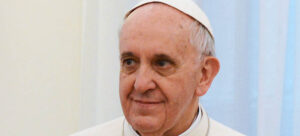 At the age of 88, following serious illness, Good Pope Francis has passed from earthly life to eternity on Easter Monday 2025. He will be most fondly remembered by all who caught his dream of a synodal church – in which every person is conscious of the equal importance of their own life in witnessing to the saving truth of the Gospel. |
I loved the Stations of the Cross written by Pope Francis for Good Friday this year
Yesterday a friend sent me this tribute to Pope Francis
Tribute
“A Hindu man, Vinod Sekar, has written one of THE most moving and beautiful tributes ever written for anyone… for the late Pope Francis.”
*The Loss of a Good Man: A Tribute to Pope Francis and the Power of Universal Faith*
I only met Pope Francis once. It was brief. Just a few moments in a crowded room filled with dignitaries and seekers, some out of duty, others out of belief. I was neither Catholic nor there on some divine pilgrimage. I was just a man in need of a little hope. And somehow, in that fleeting encounter, I received it.
It’s hard to explain without sounding overly romantic. Still, when you’re in the presence of someone truly good—not performatively good, not “publicly moral” or selectively kind—but genuinely, deeply, relentlessly good… something shifts in you. You feel lighter. You feel braver. You feel like humanity, for all its wounds and wickedness, is still worth fighting for.
That was the gift Pope Francis gave me. And I imagine, from the tears I’ve seen today and the aching silences of millions across faiths, races, and borders, that he gave that same gift to many.
Today, we mourn not just the passing of a Pope. We mourn the loss of one of the strongest chess pieces humanity had on this plane of existence.
He was a man who made kindness radical again. Who reminded the powerful that humility was not weakness. Who spoke of love not as doctrine but as duty. He was not just a religious man. He was something far more rare — he was universally spiritual.
I am a Hindu. My God wears different names. My prayers come in different rhythms. But I would have followed this man through fire. Because in his belief in God, he carried a belief in all of us. His eyes didn’t see denominations — they saw dignity. His voice, always soft but never weak, carried the weight of truth even when it unsettled the comfortable. Especially when it unsettled the comfortable.
This world has a way of chipping away at your soul. The noise, the greed, the hate, the empty rituals that masquerade as faith or patriotism or family values. It’s easy to go numb. It’s easy to give in to cynicism. But once in a while, someone comes along who reminds us that the better angels of our nature are still within reach. That goodness is still possible. That we don’t need to be perfect to do good — we just need to be brave. Pope Francis was that man.
He chose love over doctrine. He chose compassion over judgment. And most remarkably, he chose action over applause. He walked with the poor. He knelt before the discarded. He challenged the powerful not with anger, but with moral courage. And he did all of this with a smile that felt like a prayer.
He understood something many religious leaders forget: that God doesn’t reside only in temples or churches or mosques. That holiness isn’t a place — it’s a way of living. A way of seeing others. A way of choosing kindness, over and over, even when it hurts.
So yes, today we mourn. I mourn. Not just for the Catholic world, but for all of us. Because when a man like this leaves, it feels like a light has been dimmed.
But maybe — just maybe — the way we honour him is by becoming the light ourselves.
Let us remember his faith in humanity, and let it fuel our own. Let us keep making the right chess moves in this complicated, brutal, beautiful game of life. Let us speak truth with grace. Let us protect the vulnerable, question the powerful, and lift each other up not because of who we are, but because we are here together.
*Pope Francis believed in a world where dignity wasn’t conditional. Where faith was lived, not just preached. That world can still exist — if we build it.*
And maybe that’s the final gift he’s given us. A call not to despair, but to duty.
*Because as long as we carry his belief in each other, then truly, he has not left us at all.*
Vinod Sekhar
Pope Francis wrote a lovely piece on death, which I read yesterday ( Declan )
Death is one more step in life. If you are sure that the Lord will not betray you, then you can go forward with courage. The Lord himself will give you the grace to see life in death. There is an expression that I do not like: “the House of the Father” or “going back to the Father’s House,” as if our life were a round trip. It would be better to say: “Go to meet the Lord” or “I’m going towards that meeting.” There will be a meeting or encounter at the end of life. It’s a meeting I may or may not have had in life and it’s a meeting that I’ve been looking forward to or not looking forward to in my life. But in the end, we will meet God face to face.
—Pope Francis in Sharing the Wisdom
Another tribute I came across that resonated with me. Declan
A Pope in a Poncho: The Gospel of Fragility
It was not the papal cassock, the golden cross, or the solemn gaze from a palace balcony that marked April 10, 2025.
Instead, it was a fragile old man in a striped poncho, worn black trousers, and oxygen tubing, rolling quietly through the grandeur of St. Peter’s Basilica.
No proclamation, no camera crews, no ceremonial fanfare. Just a tired pilgrim in the skin of a pope, moving slowly toward the restored chair of Peter and the tomb of Saint Pius X.
To some, it was a scandal. To others, a shock. And to a few—perhaps not many—it was a moment of profound, unscripted holiness.
Because it was not the Vicar of Christ clothed in tradition but something far rarer: a leader without costume, a priest without performance, a man who dared to embody the Gospel in raw, human skin.
In an institution where clothing is language—the cassock, the skullcap, the ring—all speak of office, succession, and sacred continuity—Francis chose a language older than vestments: the language of presence.
In his beige Argentine poncho, he wasn’t signalling authority; he was invoking memory—of his homeland, of the poor, of the Jesus who walked dusty roads with no sceptre, throne, or robe worth envying.
Some saw an older man too frail to dress appropriately. Others saw disrespect for ritual. But to those attuned to the undercurrent, it was something else entirely: a gesture of undoing, the kind that refuses to uphold a performance when the soul is calling for honesty.
He didn’t come to be venerated that day. He came to be.
And in doing so, he reminded the Church—perhaps unintentionally—that the robes, collar, rituals, and relics are only bridges. They are not the water beneath.
When we strip away the grandeur, what remains is a question the Church must confront more often: What happens when the sacred no longer looks impressive? When authority arrives in a wheelchair, with sunken eyes and no cross on its chest?
Whether deliberately or by accident, Francis exposed the quiet truth: the real scandal is not the poncho, but how much we’ve come to rely on appearances to sustain our reverence.
We want our popes upright, glowing, and draped in theology. We don’t want them too human, too frail, too much like us.
But isn’t that precisely the paradox at the heart of Christianity?
*Today, when Jesus rides into Jerusalem on a colt, his official representative on earth is wheelchaired into the most ornate church on earth, dressed in an Argentinian poncho reminded us that fragility is not the opposite of faith—it may be its most honest form.*
That perhaps, in a moment like this, the Church caught a glimpse of what Jesus meant when he knelt to wash feet instead of issuing commands.
This was not the Pope as prince or priest. This was the Pope as a person, as a pilgrim, as a reminder that grace may arrive not dressed in white but in weakness.
And maybe, just maybe, that is the Church we need to become.
Johnson Kotaram
From the editorial of this weeks Tablet Journal
Let us Dream is also the title of the wonderful little book Pope Francis wrote in 2020, during the months of lockdown, with the English Catholic writer, papal biographer and former deputy editor of The Tablet, Austen Ivereigh. “I never imagined I would grow close to a pope, of all people, and can’t quite describe what the relationship was. I sometimes see myself in the media described as his friend, but that can’t be right. He was a master and a father and a loving guide, the greatest teacher of the Gospel of Jesus Christ I have known, and I was blessed that he cared for me, as he cared for everyone,” Austen writes in this week’s special issue. He last met Francis in December. “He seemed exhausted, and short of breath. I got out my recorder and asked him questions, as usual, but his voice was raspy and the answers perfunctory. So I turned it off, and said I had no more questions. ‘That’s OK,’ he said. ‘I’m just glad you’re here. Tell me what’s been happening.’ So we spoke of this and that, and we chatted, heart to heart. When he looked tired, I got up to leave. We hugged. As I left, sensing it might be the last time, it hit me how much I would miss him, what a hole he would leave. By the time the lift reached the ground floor, I was in tears.” Some of us were in tears, too, when we read Austen’s piece. Brendan Walsh
“Right up to his very last day,” Julian Paparella writes in his View from Rome, “Francis put into practice what he characterised on countless occasions as the ‘style of God’: closeness, tenderness, and compassion … This pontificate has been a new springtime of renewal in the Church; his point was not to see it all through to completion, but to open up new pathways forwards. To quote the well-known prayer associated with Archbishop Oscar Romero whom Francis canonised, he was ‘a prophet of a future not his own’.”
As a subscriber to the weekly Tablet I am always impressed by the quality of Journalism and the angles taken in reinforcing the insights and reforms established by the Second Vatican Council. I warmly recommend it to teachers to keep you informed and to assist you in keeping updated and grounded in contemporary spiritual and ethical issues Declan
Text of Mass for the Funeral of Pope Francis.
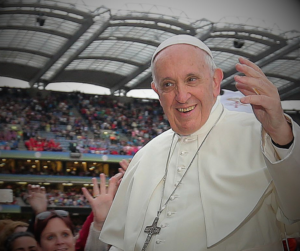
Archbishop Eamon Martin Speaks on the Death of Pope Francis
“There was something different about this pope who came to us twelve years ago from “the ends of the world”. On that very first night when he stood on the balcony of Saint Peter’s Basilica, our hearts were moved as he greeted the people with a simple ‘Buonasera’ and asked us to pray to the Lord to bless him.”
On hearing today the announcement that Pope Francis has died, my heart is filled with both deep sadness and immense gratitude, as we say farewell to a faithful shepherd who has walked closely with his people and carried their joys and sorrows in his heart.
Pope Francis’ papacy has been a profound gift to the Church and World. On behalf of the Irish Bishops’ Conference, and the Catholic faithful on the island of Ireland, I extend sympathy to Pope Francis’ family members, to those who have worked most closely with him, and to all those around the globe who loved him and will mourn his loss.
There was something different about this pope who came to us twelve years ago from “the ends of the world”. On that very first night when he stood on the balcony of Saint Peter’s Basilica, our hearts were moved as he greeted the people with a simple ‘Buonasera’ and asked us to pray to the Lord to bless him. Now we pray to that same Lord to show him mercy and welcome him to his eternal reward. Pope Francis often expressed his personal unworthiness, insisting ‘I am a sinner’. He would want us to pray now for his soul as he appears before God whom he himself presented to the world as a loving and merciful God, who understands all our weaknesses and frailties, yet loves each of us deeply.
The Catholic people of the world will mourn the loss of the late ‘holy father’, while thanking God for his tireless service as priest and bishop, and his courageous witness as servant leader of the Catholic Church. Pope Francis embodied a Church that listens, accompanies, and embraces all. His vision was not one of rigid structures or distant authority, but of a Church committed to encounter and deep solidarity with humanity. Grounded and shaped by the Latin American Theology of the People (Teología del Pueblo), Pope Francis recognised the wisdom of ordinary believers, affirmed the beauty of popular devotion, and upheld the dignity of those on the margins of both the Church and society.
From the very first days of Pope Francis’ pontificate in 2013, he had a special place in his heart for the poor, those often forgotten on the peripheries, and those who are suffering most – both globally and locally. He showed us by word – and action – that solidarity with the poor and vulnerable means looking into their faces, touching their flesh, sensing their closeness and trying to help them. Such solidarity never tolerates any assault on human life or on the human dignity of any person.
Pope Francis’ bold gestures of compassion spoke to millions across the globe – from his sincere empathy for migrants and outreach to prisoners, to his humble avoidance of many of the traditional privileges and accoutrements of the papacy.
Pope Francis was not just a leader of Catholics, or even of Christians; rather, he was a global leader who spoke with much needed balance and authority on behalf of countless people of goodwill around the world. He went the extra mile in reaching out to those of other Christian denominations and world faiths. He built friendships across religious divides because he firmly believed that we are all brothers and sisters. He abhorred war as a ‘defeat for humanity’ and he continuously advocated for peace building, reconciliation and cooperation between peoples, faiths and nations in our very troubled world.
For someone who took up such a challenging role at the age of 76, Pope Francis appeared happy and youthful and, until recently, he seemed to have boundless energy! He never lost a minute in promoting the Good News of Christ to children, young people, parents and the elderly all over the world, travelling to many faraway places to bring the joy of the Gospel.
At the Vatican, he insisted on reform of the Curia and of the global Church’s safeguarding procedures, courageously confronting the terrible sins and crimes of abuse in the Church and its traumatic impact on victims, survivors and the wider faithful.
In choosing the name Francis, he set himself the demanding task of following in the footsteps of the great saint of Assisi – modelling a preferential option for the poor, building peace and friendship everywhere, and highlighting the urgent need for the care and protection of God’s creation. He alerted the entire world to the ‘cry of the Earth’ and the ‘cry of the poor’, emphasising that all creatures are connected by the love of the Creator; he constantly highlighted the imperative facing humanity of caring for our common home and protecting the gifts of creation for future generations.
Here in Ireland we will always remember that Pope Francis made time to visit us when the World Meeting of Families was held in Dublin in 2018. He brought us a message of encouragement and consolation, stressing the fundamental importance of family and marriage for society and for the Church. But even in that hectic, short visit he emphasised the importance of ‘encounter’- meeting with the homeless and hungry at the Capuchin Day Centre, conversing with couples preparing for marriage, and travelling to Knock to pray with, and for, the people of Ireland. Most importantly, however, he wanted to take time to listen and respond to the heartfelt, painful stories of survivors of abuse.
No doubt in the coming days and weeks many more memories of Pope Francis will emerge, but for me it was his closeness and friendship with Christ which stood out most of all – in his compassion for the suffering, and the way he placed the vulnerable at the centre of his ministry – the poor, refugees, victims of war, human trafficking, and all who are exploited, overlooked or excluded by Church or by society. He wanted to bring them in from the cold.
As a leader, Pope Francis continually emphasised the importance of listening and discernment, calling the Catholic Church to be a ‘synodal Church on mission’. He wanted everything in the Church to be put in what he called ‘a missionary key’. The Church cannot be shut up in the Sacristy; it should neither come across as a dusty museum, nor, on the other hand, as some kind of NGO. The Church is a home for the lost and wounded. Like a ‘field hospital’, it is entrusted with the task of welcoming the sinner with tenderness and mercy, and presenting the joyful message of salvation in Christ. This, he said, impels her to go out and spread the Good News, accompanying and calling people back to the person that God wants them to be. Now, as Pope Francis goes to God, it is up to us to continue to make known that ‘God loves us first’, and that we in turn are called to love one another as brothers and sisters who know that Christ is alive; Christ is our hope!
In his 2020 encyclical Fratelli Tutti, on fratenity and social friendship, Pope Francis posed a series of ‘real’ questions for leaders to reflect upon, such as: ‘How much love did I put into my work?’; ‘What did I do for the progress of our people?’; ‘What mark did I leave on the life of society?’; ‘What real bonds did I create?’; ‘What positive forces did I unleash?’; ‘How much social peace did I sow?’; and, ‘What good did I achieve in the position that was entrusted to me?’.
No doubt he often put these same questions to himself.
It is my hope and prayer that our loving and merciful God shall give Pope Francis the answer to those questions today: ‘You did well, Francis; well done, good and faithful servant.’
At the outset of his Petrine ministry, Pope Francis urged us in his 2013 Apostolic Exhortation, Evangelii Gaudium (The Joy of the Gospel, (86)): ‘Do not let yourselves be robbed of hope.’ May his legacy continue to bear fruit in a Church that listens, serves, and dares to dream.
Pope Francis, thank you.
Sacred Heart of Jesus, have mercy on his soul.
Amen.
+ Archbishop Eamon Martin
Archbishop of Armagh, Primate of All Ireland
Catholic educators respond to death of Pope Francis

Following the death of Pope Francis on 21 April 2025, the Ireland’s Catholic Education Partnership published the following statement:
It was with profound sadness that the Board of Catholic Education Partnership (CEP) learnt of the death of Pope Francis. Our prayers are joined with that of our brothers and sisters in faith throughout the world that Jesus Christ may grant Pope Francis rest in the House of the Father.
Dr Marie Griffin, chairperson of CEP, said, “Catholic educators remember Pope Francis with gratitude and fondness for his leadership and inspiration. In the Global Compact on Education he gave us a pathway to compassionate care and respect for all, especially the marginalised. In it, he drew our attention to the twin ecological challenges of our age: the ecological crisis of our common home and that of the ecology of the human person. In it, he placed families and the human person at the centre of concern for educators, emphasising the need to listen to the voices of the young and to find new ways of understanding economics, politics, growth and progress. In time, I am confident that this will be seen as a key aspect of the rich legacy of his pontificate.”
The Chief Executive of CEP, Alan Hynes, noted, “that the last message on social media posted by Pope Francis reminded us that the resurrection of Christ captures ‘the entire meaning of our existence, for we were not made for death, but for life’. This is the Golden Thread running through Catholic education – that human life has a meaning, purpose, and destiny, far beyond the limitations of this mortal life.
“Time and time again, Pope Francis drew attention to the significance of human dignity, made as we are in the image of God. In Fratelli Tutti he reminds us that ‘as a community, we have an obligation to ensure that every person lives with dignity and has sufficient opportunities for his or her integral development.’ These words serve as a mission statement for Catholic education, words that we will seek to honour as we continue on with our work in the light of Pope Francis’ profound legacy to the Church and to the world.”
The Catholic Education Partnership was established in 2020 and replaced the Catholic Schools Partnership. The purpose of the CEP is to provide an authoritative and unified voice for the Catholic education sector at primary, post-primary and tertiary levels on the island of Ireland.
The Bishops’ Communications Office in Maynooth has made available digital Books of Condolence for people to record their sympathy and these are available on the homepage of catholicbishops.ie, on the bishops’ social media platforms of Facebook, Instragram, X, Linkedin and on BlueSky.
Homily at Funeral Mass
 RE SOURCE
